Entryway Plants: Decorating With Greenery by the Door
Match a plant to the light and drafts your entry really has, then style it with the right shape, pot and grouping. Includes dried and faux options for dark spots.
A plant does something no object by the door can: it adds a living shape, a soft outline and a color that goes with every palette. Even one pot on a console makes the space feel looked after.
The catch is that entries are hard places for greenery. They tend to be dim, they get a blast of outside air every time the door opens, and floor space is tight. Choosing entryway plants is therefore less about favorite species and more about being honest about the spot, then picking a shape and a pot that suit it.
Start with the light your entry really gets
Stand in the entry around midday with the lights off and judge it as it is, not as you wish it were. Then match the plan to one of four situations.
- Bright: a glazed door, a sidelight or a window close by, with sun reaching the floor for part of the day. Most leafy plants sold for indoor use have a chance here, including larger statement plants.
- Medium: daylight you can read by, but no direct sun. Look for plants labeled for indirect or moderate light.
- Low: light borrowed from the next room. Choose plants commonly sold as tolerant of low light, such as snake plant, ZZ plant, pothos or cast iron plant, and expect slow growth.
- None: no window at all. Skip living plants and use dried stems, branches or a good faux plant instead.
Read the grower’s label for the light a plant needs, and treat general background on houseplants as a starting point only. If the bigger problem is the gloom itself, the guide to brightening a dark entryway deals with that side of things.
Think about the draft from the door
A plant by the front door meets cold gusts in winter and hot, dry air in summer, sometimes several times an hour. Thin, delicate leaves tend to show it first with brown edges or dropped foliage.
Two adjustments help. Place the plant a step or two out of the direct line of the open door, beside the console or at the far end of a bench instead of right at the threshold. And in a very exposed entry, keep the living plants small and easy to move, or let dried and faux pieces do the job in the coldest months.
Three plant shapes that do the job
One tall floor plant
An upright plant in a floor pot adds height where most entries have none. It fills an empty corner, softens the edge of a console or balances a mirror on the other side. Choose a narrow, vertical shape so the leaves stay out of the walking path, and aim for a height that reaches somewhere between the tabletop and the top of the mirror.
A trailing plant on a shelf
Stems that spill over an edge break the hard horizontal line of a shelf or ledge. Set the pot at one end, not the center, and let the trail fall down the side where nothing is in its way. The method for balancing the other objects is in the guide to styling an entryway shelf.
A small pot on the console
A compact plant in a pot about the size of a mug is the easiest entry point. It sits among books, a lamp and a tray as the one living element, and it can move to a brighter room for a week when it looks tired.
Treat pots and stands as part of the palette
With plants for entryway decor, the container matters as much as the leaves. A pot is a block of color and material at a height where people notice it.
- Repeat your accent color once: a terracotta pot that echoes the door, or a glaze that picks up a tone from the rug.
- Keep to one or two pot materials in view. Matte ceramic with a woven basket is a calm pairing; five different finishes are not.
- Use a basket as an outer cover for a plain plastic grower pot, with a saucer or waterproof liner inside it. The entryway basket ideas explain which weaves suit which spot.
- A plant stand lifts a medium plant to floor-plant height without the cost in floor area of a huge pot.
Group in odd numbers and vary the heights
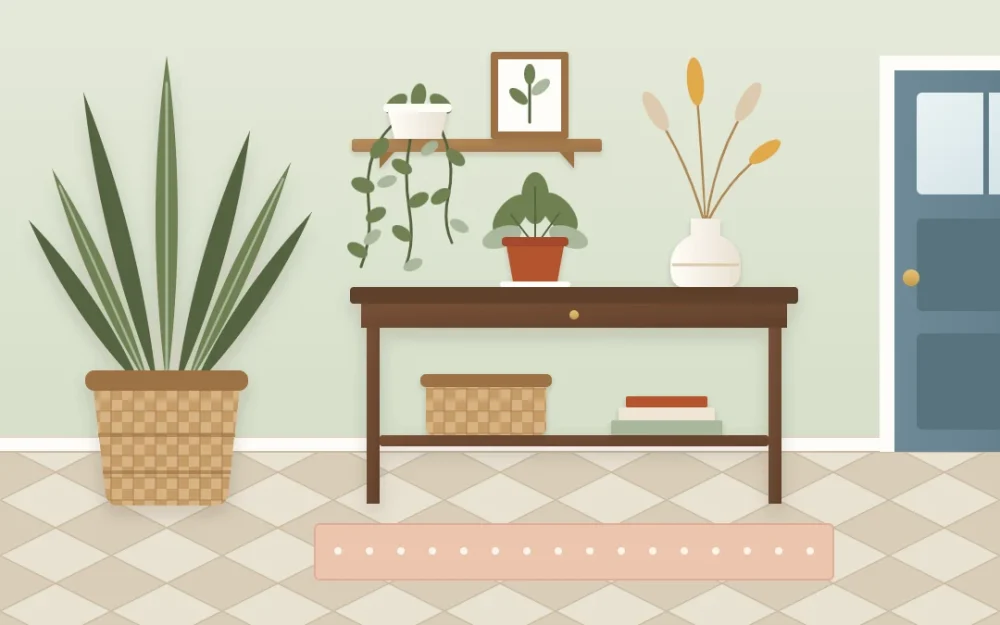
One plant is a detail. Three, at different heights, become entryway greenery that reads as a planned composition. A simple arrangement is one tall plant on the floor, one mid-height piece such as a vase of stems on the console, and one small pot or trailing plant higher up on a shelf.
Odd numbers tend to look more natural than pairs, and a clear difference in height keeps the group from merging into a single green mass. Vary the leaf shape too: upright blades next to round leaves next to a fine trailing stem. Then stop. In a small entry, three is usually the limit before the plants begin to crowd the path.
Tip
Step back to the open door and squint. If the green shapes form a loose triangle, with one high, one middle and one low, the grouping is working.
Dried stems, branches and faux plants for dark or drafty entries
Where nothing living will cope, you still have good options. A tall vase of bare branches gives the height and line of a floor plant. Dried grasses and seed heads add soft texture and a warm, pale color.
Faux plants in an entryway work best when you choose them as carefully as real ones. Look for matte leaves, some variation in color, and stems that can be bent into an uneven, natural shape. Put the plant in a real pot with a layer of soil, moss or pebbles on top, and dust it now and then. One convincing faux plant is better than several obvious ones.
Protect the surfaces underneath
Water and wood finishes do not mix, and an entry floor already has enough to cope with. Put a saucer under every pot, or use a decorative outer pot with no drainage hole and a waterproof liner. A thin cork or felt pad beneath the saucer keeps grit and moisture off a tabletop.
The simplest habit is to water at the sink, let the pot drain fully, and only then return it to its place. It keeps drips off the console and gives you a moment to turn the plant so it grows evenly.
Frequently asked questions
Can a plant live in an entryway with no window?
A living plant needs light to keep growing, so a windowless entry is a poor long-term home for one. Use dried stems, branches or a well-made faux plant there instead, or rotate a small real plant between the entry and a brighter room every week or two.
Where should a plant go in a small entry?
Choose a spot out of the walking path and out of the direct line of the open door. A small pot on the console or a trailing plant at one end of a shelf adds green without using any floor. If you want a floor plant, pick a narrow, upright shape.
How do you make a faux plant look real?
Choose one with matte leaves and some variation in color, then bend the stems so the shape is slightly uneven. Set it in a real pot and cover the base with soil, moss or pebbles. Dust the leaves regularly, because a dusty shine is what gives most faux plants away.