Entryway Shelf Styling: How to Decorate a Shelf by the Door
A simple method for a shelf by the door: split it into a working third and a styled two-thirds, build three heights, add a key dish and a trailing plant, then edit.
At a glance
- Difficulty
- Easy
- Time
- About 20 to 30 minutes for a shelf that is already up
- Best for
- Entries with one or two floating shelves or a ledge near the door
- Renter note
- Styling needs no fixings; putting up a new shelf does, so choose them for your wall type and ask before drilling
What you need
- Small framed print
- One tall vase or bottle
- One low bowl or object
- Small dish or lidded box for keys
- Small trailing plant, real or faux
An entryway shelf has two jobs that pull against each other. It has to catch keys, mail and sunglasses the second you walk in, and it is also one of the first styled surfaces anyone sees. Left to chance, it turns into a narrow strip of clutter at eye level.
The answer is not more objects or fewer objects. It is a simple split: one part of the shelf works, the rest is composed, and the two never mix. The method below suits a single entryway floating shelf or a pair, and it gives every item a reason to be there.
Divide the shelf into a working third and a styled two-thirds
Picture the shelf in three roughly equal parts. The third nearest the door is the working zone, where daily things land. The remaining two-thirds is there to be looked at. Treat the proportion as a loose guide: on a very short shelf, the working zone may be nothing more than one small dish.
Keep the working end closest to the door, because that is where your hand reaches first. If the dish sits at the far end, keys will end up on the styled part anyway.
Know what a composed shelf looks like
A shelf reads as crowded when it holds many small objects of similar height. The eye cannot find a starting point, so it sees one busy band. A composed shelf holds a few things at clearly different heights, with bare shelf showing between them.
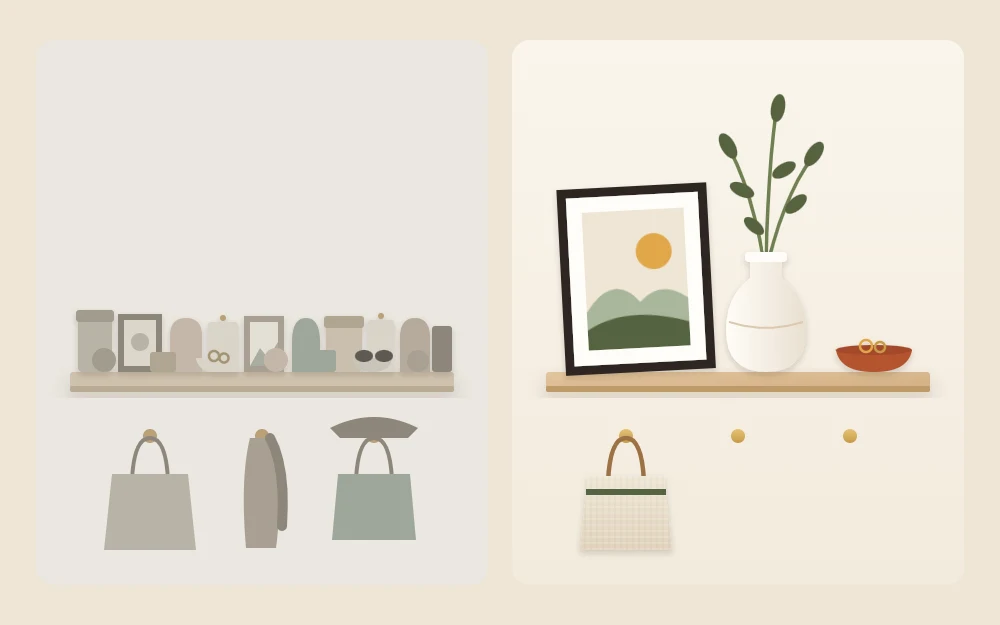
Shelf styling by the door, step by step
- Clear it completely. Take everything off and look at the empty shelf from the open door. That view, not the one from directly in front, is the one you are styling for.
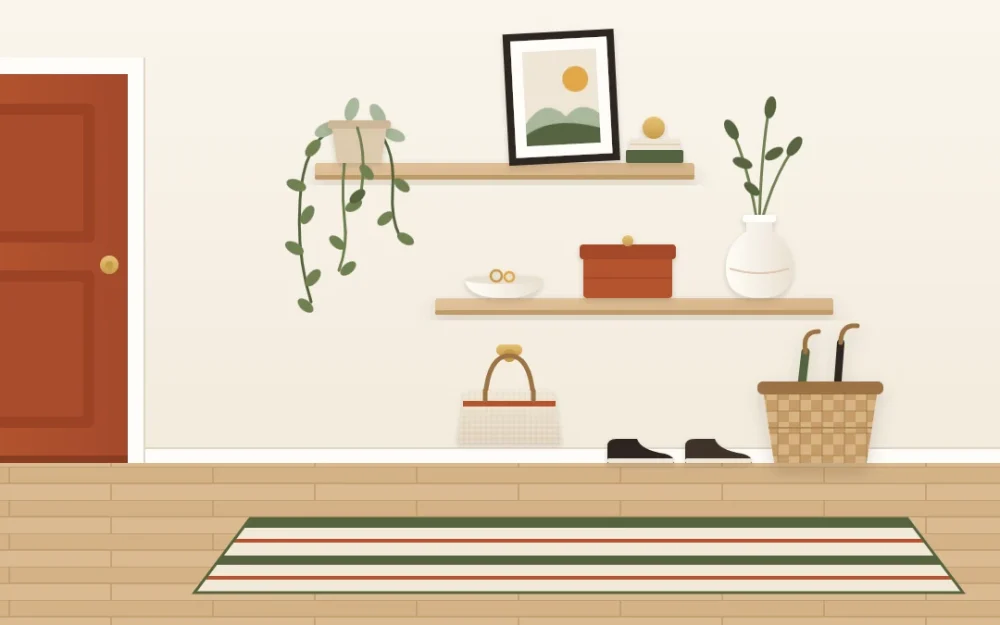
- Lean a frame at the back. A small framed print, roughly 8 by 10 in (20 by 25 cm) as a starting point, gives the styled end a backdrop. Leaning looks relaxed and lets you swap the print whenever you like.
- Add one object with height. A slim vase, a candlestick with a flameless LED candle or a tall bottle goes beside the frame, overlapping its edge slightly so the two read as a pair.
- Add one low object in front. A small bowl, a smooth stone or a short stack of two little books sits forward of the tall piece. Tall, medium and low is the whole trick.
- Place the key dish. Set a small dish or lidded box in the working third. Choose one that looks good empty, since it will be seen that way most of the day.
- Finish with a trailing plant. A small pot at the far end, with stems spilling over the edge, softens the hard line of the shelf. Real or good faux both work; the guide to choosing entryway greenery for the light you have helps you decide.
- Step back and remove one thing. Return to the door. If anything blocks something else or you cannot name its job, take it away.
Repeat a color from the rug or the door
A shelf looks deliberate when it shares a color with something nearby. Pick one tone from the rug, the door or a cushion on the bench and use it once or twice on the shelf: the vase and the mat inside the frame, for example. Everything else can stay quiet in wood, white, cream or black.
Two repeats are enough. Beyond that, the shelf starts to look matched rather than styled.
Zigzag the visual weight across two shelves
With two shelves, avoid stacking the heaviest-looking things directly above each other. If the leaning frame and plant sit at the left of the upper shelf, put the largest piece on the lower shelf toward the right. Your eye then travels in a zigzag from one shelf to the other, and the pair feels balanced.
Keep the working zone on the lower shelf, where it is easy to reach, and let the upper shelf be mostly decorative. A common starting point is about 12 in (30 cm) of space between the shelves, enough for one taller object without the arrangement feeling cramped.
Shelf with hooks styling
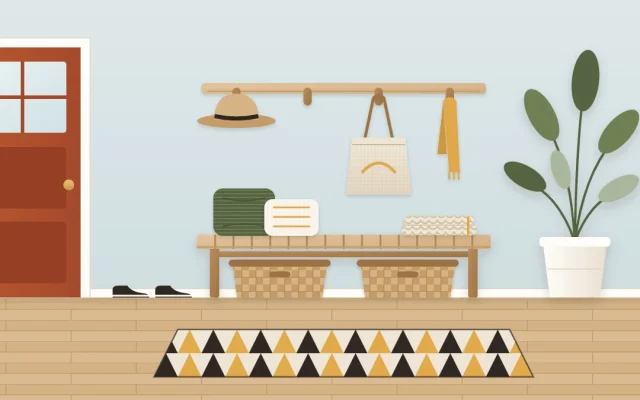
When a shelf has hooks or pegs beneath it, what hangs there becomes part of the picture. Balance the two levels: if the shelf is full at one end, leave the hook below that end empty and use the hooks at the other end. One bag, one hat and one scarf look intentional; a full row of coats hides the shelf and makes anything on it look fussy.
The guide to making a hook rail part of the decor covers arrangement and spacing in detail.
Entryway ledge decor for very shallow shelves
A picture ledge is too shallow for bowls and pots, so shift the method. Lean two frames of different sizes, overlapping, and let a single small object stand beside them. Move the keys off the ledge entirely, to a tray on a nearby surface; the guide to styling a catchall tray shows how to keep that tidy too.
Keep it light and edit weekly
A shelf by the door collects things. Once a week, empty the dish, recycle the mail and return anything that drifted there to where it belongs. Then check the three heights are still visible and the bare stretches are still bare.
Light objects are the right choice for a shelf in any case: small ceramics, paperbacks, a little plant. Large stacks of books and big planters belong on the floor or a console.
Before you hang anything
If you are putting up a new shelf, choose the fixings for your wall type and for the weight the shelf and its contents will carry, and follow the manufacturer instructions for both the shelf and the hardware. If you are unsure, ask someone experienced for help. In a rental, check your lease or ask before making changes.
Frequently asked questions
How many things should go on a small entryway shelf?
On a short shelf, three to five pieces is a comfortable range: a leaning frame, one tall object, one low object, a key dish and perhaps a small plant. If you cannot see bare shelf between the groups, remove one piece and look again from the door.
Where should the key dish go on the shelf?
Place it at the end closest to the door, because that is where your hand lands as you walk in. Keeping daily items in that one zone stops them from spreading across the styled part, and a dish that looks good empty keeps the shelf tidy during the day.
How do you style two floating shelves so they look balanced?
Offset the visually heavy pieces instead of stacking them. If the largest item on the upper shelf sits to the left, put the largest item on the lower shelf to the right. Use the lower shelf for keys and mail and keep the upper shelf mainly decorative.