Entryway Basket Ideas: Decorative Baskets That Hide the Everyday
How to choose baskets for the entry by material, size and placement so they add texture and warmth while keeping scarves, bags and blankets out of sight.
A basket is one of the few things by the door that does two jobs without looking as if it is trying. It brings a woven, handmade texture to a spot made mostly of hard surfaces (door, floor, wall, table), and it swallows the scarves, leashes and shopping bags that would otherwise sit in full view.
The trick with entryway baskets is to choose them the way you would choose a vase or a lamp: by material, shape and proportion first, and by what goes inside second. Pick them only for capacity and you end up with a row of bins. Pick them as decor and the everyday mess gets hidden as a side effect.
What each basket material adds
Material decides how a basket reads from the door: rustic or crisp, soft or graphic. Use this comparison to narrow the choice before you think about size.
| Material | Look and texture | Where it works best |
|---|---|---|
| Seagrass | Soft, matte, greenish-tan weave with a slightly uneven surface | Floor baskets and pairs under a table in relaxed, natural schemes |
| Rattan or wicker | Crisper weave with a clear pattern and firm sides | Square baskets on a shelf or under a bench, where a neat outline matters |
| Wire or metal | Open, graphic lines that leave the contents visible | Modern entries, and only for things worth seeing, such as a rolled blanket |
| Felt or thick fabric | Smooth and quiet, reads as a soft block of color | Small entries and pale palettes where a woven pattern would feel busy |
| Lidded, any material | A closed, calm shape with nothing on show | Gloves, chargers, pet gear and anything else you would rather not look at |
Natural fibers vary in tone from one batch to the next, so if you want a matching pair, get both at the same time and compare them side by side in daylight.
Choose the size for the spot, not the contents
Measure the gap the basket will sit in before you think about what it has to hold. A basket that fits its spot looks deliberate even when it is half empty; one that is too small looks like something left behind.
- Under a table: leave some air above the rim, roughly 2 to 4 in (5 to 10 cm) as a starting point, and keep the front of the basket behind the front edge of the tabletop.
- On the floor beside a bench or door: a basket that reaches about seat height or a little lower has enough presence to stand alone.
- On a shelf: a basket filling around two-thirds of the shelf depth, as a loose guide, sits securely without looking crammed in.
The space below the tabletop has its own set of options beyond baskets, covered in the guide to what to put under a console table.
Pairs, trios and singles
A matching pair under the console
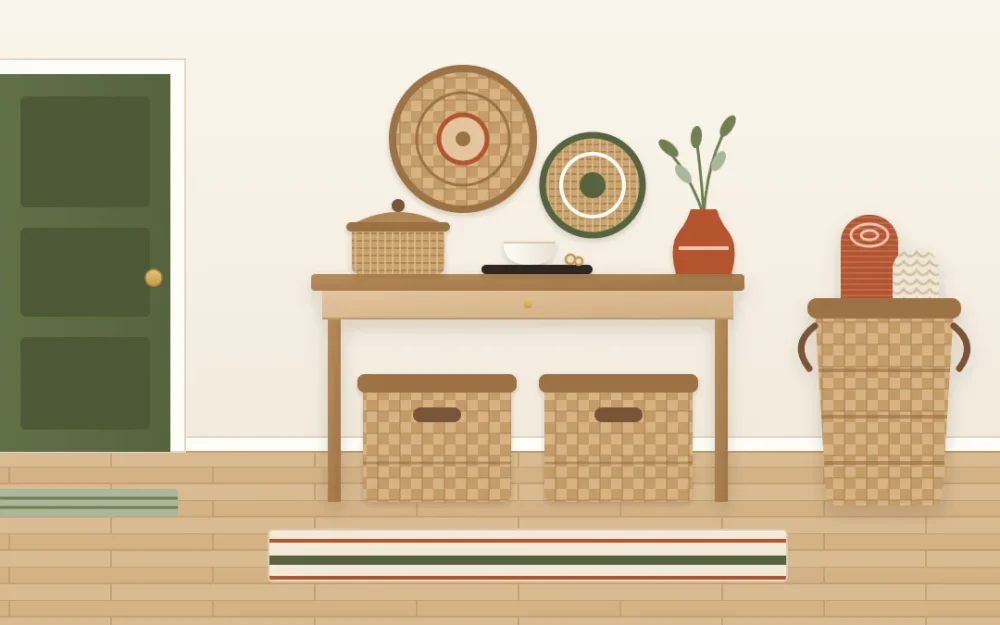
Two identical baskets side by side give a leggy table a solid base and a sense of symmetry. A basket under console table legs works best when the pair fills most of the width between them, with a small gap in the middle. Square or rectangular shapes line up more neatly than round ones here.
One large floor basket
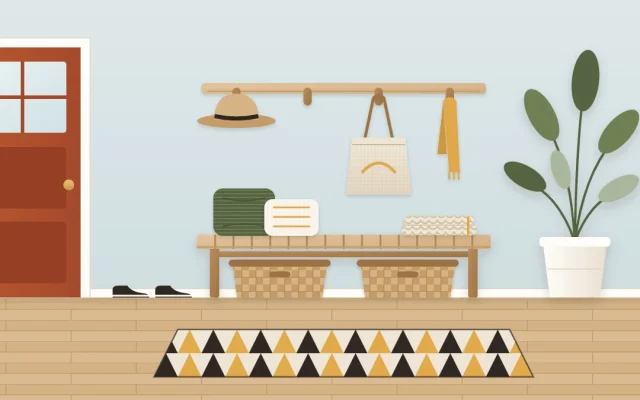
A single tall, round basket is the relaxed option. Use it for a rolled throw, a few dry umbrellas standing upright, or spare cushions. Because it stands on its own, it can fill an empty corner or the end of a bench. If you have a seat by the door, the bench styling ideas show how a basket and a bench share the same wall.
A small basket on a surface
A palm-sized lidded basket on the console or a shelf takes keys, sunglasses or mail and adds one more woven note higher up, so the texture is not all at floor level. Three baskets at three heights (floor, under the table, tabletop) is a simple trio that pulls the eye up the wall.
Wall baskets as art
Flat woven baskets and shallow trays make a light, textured alternative to framed prints. Group three or five in different diameters, let two of them almost touch, and keep the cluster roughly as wide as the furniture below it. Arrange them on the floor first and adjust until the outline looks balanced, then transfer the layout to the wall.
Before you hang anything
Even light baskets need hardware chosen for your wall type and the weight of the piece, used as the manufacturer instructions describe. In a rental, check your lease or ask before making changes.
Mixing weaves with wood, ceramic and metal
Woven basket decor depends on contrast. A basket looks richest next to something smooth: a glazed ceramic lamp, a metal tray, a painted wall. Next to more rough texture it disappears.
- Limit yourself to two different weaves in one view. More than that starts to look like a shop display.
- Echo a tone that is already there. Honey-colored rattan repeats an oak console; a gray-washed weave suits cooler floors.
- Use dark or black-stained baskets where you want a sharper, more modern outline against a pale wall.
- Let handles count as detail. Leather tabs or rope loops add a second material without adding another object.
Keep what shows inside tidy
Give each basket one purpose. A basket for scarves that also collects mail, a bike lock and a single glove will look like a catch-all within days, however good the weave is. One job per basket keeps the contents looking even, and it means you know where to drop things without thinking.
With an open basket, the contents are part of the picture, so treat them that way: roll the blanket instead of folding it, stand umbrellas upright, and keep the fill below the rim. For everything else, choose a lid or a fabric liner that folds over the top.
Tip
If you like a pared-back entry, one closed basket can replace several open ones. The approach is described in the guide to a minimalist entryway.
Entryway basket styling mistakes to skip
When choosing decorative baskets for entryway corners and shelves, these are the habits that undo the look:
- Too many small baskets. One generous basket has more impact than four little ones scattered around.
- Tones that almost match. Either match properly or contrast clearly; nearly-the-same tans look accidental.
- Overfilling. Contents rising above the rim cancel the calm shape you chose.
- Blocking the path. Keep baskets clear of the door swing and the walking line into the home.
Frequently asked questions
What size basket should go under a console table?
Measure the opening first. As a starting point, leave a few inches of air between the basket rim and the underside of the table, and keep the basket behind the front edge of the top. A pair that fills most of the width between the legs usually looks more settled than one small basket.
Are lidded or open baskets better for an entry?
It depends on what goes inside. Open baskets suit things that look good on show, such as a rolled throw or upright umbrellas. Lidded baskets suit small, mixed items like gloves and chargers, because the closed shape stays calm whatever is in it.
How many baskets are too many in an entryway?
There is no fixed number, but two or three is plenty for most entries. Once every surface has its own basket, the weave stops reading as an accent and starts to look like storage. One generous basket usually has more effect than several small ones.