Minimalist Entryway: A Calm Look With Fewer, Better Pieces
A five-step reduction method for a calm entry: list the jobs, allow one piece for each, keep to two tones and one natural material, and plan the empty wall as carefully as the furniture.
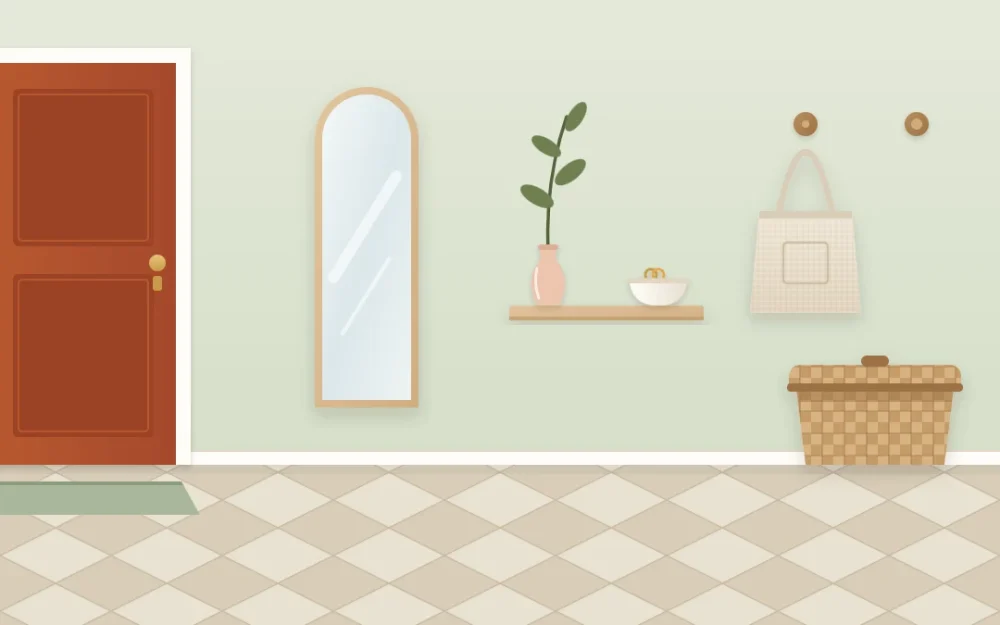
A minimalist entryway is not an empty one. It is an entry where every piece has a job, nothing is doubled up and the bare wall around those pieces is doing as much as the pieces themselves.
Getting there is less about buying the right slim furniture and more about subtraction in a sensible order. The method below starts with what the space has to do, gives each task one good-looking answer and then stops.
Step 1: List what the entry must do
Stand at the open door and write down the jobs, not the objects. For most homes the list is short:
- A place to put keys and whatever is in your hand.
- A last look before you leave.
- Somewhere for the coat and bag you are using today.
- A spot for the small things that would otherwise sit on the floor.
If a job does not happen at your door, cross it off. Perhaps nobody sits down to put on shoes, or the mail goes straight to the kitchen. A shorter list is the whole basis of an entryway with fewer pieces.
Step 2: Allow one piece for each job
Now match each job to a single piece, and choose the slimmest version that does it well.
- Landing spot: a short wall ledge or a slim console, not both.
- Last look: one mirror, tall and narrow if the wall is small.
- Coat and bag: two or three hooks or pegs, spaced generously. A long rail invites a long row of coats.
- Floor items: one closed basket with a lid, so what is inside never becomes part of the view.
Shoes are the usual sticking point. If more than a pair or two need to stay by the door, a slim closed cabinet keeps the calm, and it can replace the console altogether. The guide to shoe storage that still looks styled compares the options.
Before you hang anything
A ledge, mirror or hook fixed to the wall needs hardware chosen for your wall type, the weight it will carry and the manufacturer instructions. Get help with anything heavy if you are unsure. In a rental, check your lease or ask before making changes.
Step 3: Choose two tones and one natural material
Minimal entryway decor depends on a quiet palette, because there is so little else to look at. Pick two tones that sit close together, such as warm white with a soft gray-beige, or cream with pale clay. Then pick one natural material that repeats: oak, ash, rattan, linen or unglazed ceramic.
After that, hold the line. A ledge, pegs and mirror frame in the same wood read as one decision. Three different woods read as three purchases.
Step 4: Compose the empty space
Negative space is not what is left over. It is part of the arrangement, so decide where it goes.
- Group the pieces toward one side of the wall and leave the other side completely clear, instead of spreading everything evenly.
- Line things up: the edge of the mirror with the end of the ledge, the pegs level with each other, the basket directly below.
- Leave most of the ledge bare. One small bowl is enough.
- Keep the floor visible. A clear stretch of floor does more for calm than any object you could add.
A useful check: squint from the doorway. You should see two or three clear shapes and a lot of wall, not a scatter of small dots.
Tip
Cut paper shapes the size of the mirror and ledge and tape them up for a day before committing. It is much easier to judge the empty space when the pieces are only paper.
Step 5: Add one living or handmade thing
This is the step that keeps the look from feeling sterile. Add a single thing with some life or irregularity in it: one stem in a small vase, a hand-thrown bowl with an uneven rim, a basket where you can see the pattern of the weave, a small plant with a simple shape.
One, not three. Its job is to show that someone chose this, and it works because nothing else competes with it.
Minimal versus bare: where the warmth comes from
A bare entry has little in it by accident. A minimal one has little in it on purpose, and you can feel the difference. With color and objects reduced, warmth has to come from three other places.
Texture
Matte ceramic, visible wood grain, a nubby wool runner, a linen shade. Smooth, glossy, all-white surfaces are what make sparse rooms feel cold.
Light
A small plug-in or rechargeable lamp on the ledge, fitted with a warm bulb, gives the wall a soft pool of light in the evening. It makes emptiness feel restful instead of unfinished.
Proportion
Fewer pieces can each be a little bigger. A tall mirror and a generous basket look calmer than a small mirror and a small basket lost on a large wall.
If you like this restraint but want a touch more contrast or one bold piece, a modern entryway with clean lines and warmth sits just next door.
Everything else lives elsewhere
The clutter-free entryway look lasts only if the entry holds today’s things and nothing more. That is a styling decision, not a storage project. The peg takes the coat you are wearing this week, and the rest goes to a closet. The bowl takes keys, not receipts.
When something new lands by the door, ask which piece it would replace. If the answer is none, it belongs in another room. For help deciding which everyday items earn a visible spot, and how to make them look good, see the guide to balancing decor and function in an entryway.
Simple entryway ideas like these are easy to live with precisely because there is so little to maintain. Straighten the bag, empty the bowl, and the entry looks the way it did on the first day.
Frequently asked questions
How many pieces should a minimalist entry have?
There is no fixed number, but four or five is a realistic target for most homes: a ledge or slim console, a mirror, two or three hooks and one closed basket. Count the jobs your entry really has to do and allow a single piece for each one.
How do I keep a minimal entry from looking unfinished?
Make the few pieces slightly larger, line them up carefully and add texture and light. Visible wood grain, a woven basket, a wool runner and a small lamp with a warm bulb give depth. One living or handmade item, such as a single stem in a vase, shows the space was composed on purpose.
Can a minimalist look work in a busy household?
Yes, if the visible limit is clear to everyone: one coat and one bag per peg, keys in the bowl, small items inside the lidded basket. Everything beyond the current day's things goes to a closet in another room. A closed cabinet helps where several pairs of shoes must stay near the door.