Entryway Rugs and Runners: Size, Shape and Placement
How to choose a rug or runner for the entry: match the shape to the floor, leave an even border, check that the door clears it and tape the outline before you buy.
At a glance
- Difficulty
- Easy
- Time
- About 20 to 30 minutes to measure and tape
- Best for
- Anyone about to buy a rug or runner for the space inside the front door
- Renter note
- No fixings needed; a rug and pad move out with you
What you need
- Tape measure
- Painter's tape
- Pencil and paper
- Rug pad suited to your floor type
The floor is the first thing your feet meet and one of the first things your eye lands on when the door opens. An entryway rug sets the color and texture for everything above it, and the wrong size or thickness shows up fast: a door that drags, a rug that floats in the middle like a postage stamp, a runner that stops short.
Most of those problems are solved before you buy, with a tape measure and a roll of painter’s tape. Start with the shape of the floor, then the size, then the material, and check the door last.
Let the floor choose the shape
The outline of the rug should repeat the outline of the floor it sits on. A long rug in a square space, or a square rug in a corridor, tends to fight the room.
| Entry shape | Rug shape | How to place it |
|---|---|---|
| Long and hall-like | Runner | Centered between the walls, running in the direction you walk |
| Square or nearly square foyer | Rectangle or square | Centered on the floor, clear of the door swing |
| Large foyer with a center table | Round | Centered under the table, wide enough to show all around it |
| Door opening into a room | Small rectangle | Just inside the door, long side parallel to the threshold |
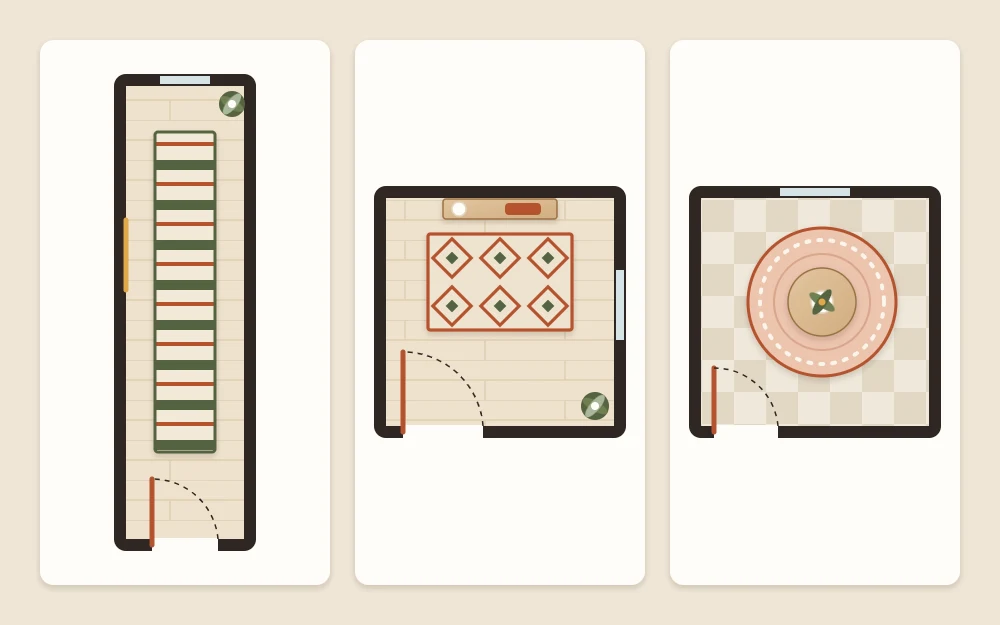
A corridor-like entrance raises its own questions about furniture and walls as well as the floor; the guide to decorating a long, slim entry covers those. For a generous hall with a center table, see the ideas for furnishing a larger foyer.
Entryway rug size: leave a border of bare floor
A rug looks intentional when floor shows evenly around it. As a rule of thumb, leave roughly 4 to 6 in (10 to 15 cm) of bare floor on each side of an entryway runner in a narrow hall, and about 12 to 18 in (30 to 45 cm) around a rug in a wider foyer. These are starting points; the aim is an even margin, not a particular number.
Go as large as that border allows. A rug that is too small is the more common mistake, because it makes the floor look patchy and gives you nowhere to stand with both feet while you take off a coat.
Hallway runner placement
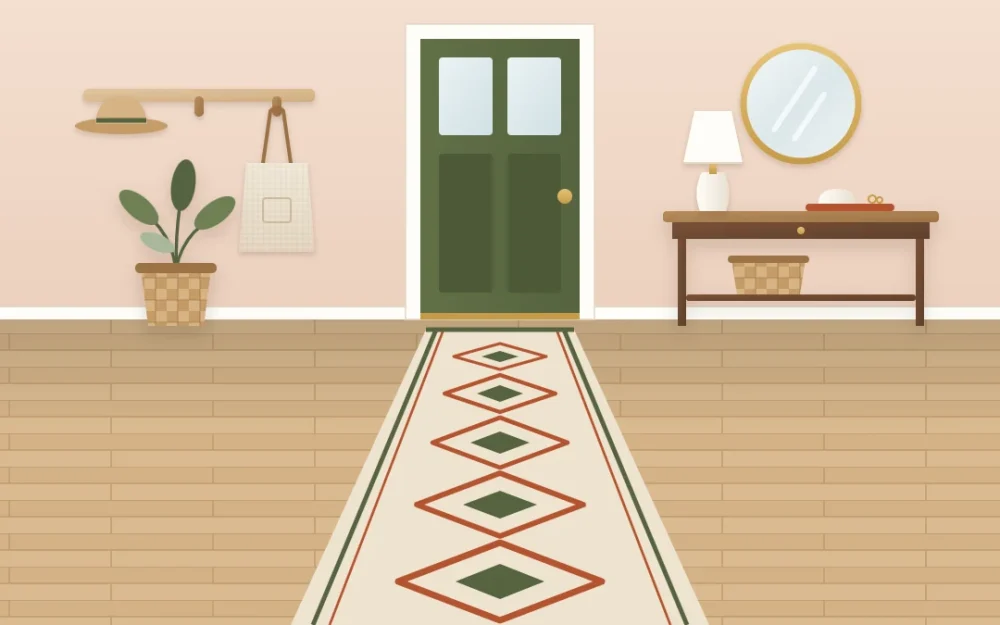
For hallway runner placement, think about the two ends. Leave a similar strip of bare floor at each end as you have at the sides, and stop the runner before it reaches a doorway into another room. If furniture stands along one wall, either keep all of its legs off the runner or put the front legs on it consistently. Half on, half off by accident looks unplanned.
Check that the door clears it
A front door rug has to sit under a moving door, or just beyond it. Before you choose, look at the gap between the bottom of the door and the floor, and remember that a rug pad adds height too.
- If the gap is small, choose a flat-woven or very low-pile rug, or place the rug just outside the arc of the door.
- If the door swings over the rug, open it fully and slowly once the rug is down to check that it does not catch the edge.
- If nothing thin enough will fit, start the rug where the swing ends and use the bare floor inside the arc for a slim mat.
Pick a weave for a doorway
Thickness is a practical and a visual choice. Flat-woven rugs, such as cotton or wool flat weaves and indoor-outdoor styles, lie close to the floor, show pattern crisply and are easy to shake out. Low-pile rugs feel a little softer underfoot and still sit low. Deep, shaggy piles are better saved for rooms further inside, where doors and grit are not part of daily life.
Look at the edges as well. A bound or hemmed edge gives a clean line against the floor; fringe is charming but tangles and can creep under a door.
Choose pattern and color that forgive daily use
The entry takes more traffic than almost any other floor. A rug with some movement in it, such as a small repeat, a stripe, a diamond or a mix of two or three tones, hides the odd mark far better than a flat pale color. Mid-tones are the most forgiving; very light and very dark solids both show everything.
Take one color from the rug and repeat it higher up, in a cushion, a vase or a lamp base, so the floor connects to the wall. If you have not settled on colors yet, choosing a palette for the entry comes first, and the rug is often the easiest place to carry the accent.
Tip
Run stripes along the length of a hall to stress its length, or across it to make the floor read a little wider.
Layer a mat with a decorative rug
Two layers can look better than one. Put a small, tough outdoor-style mat right at the threshold to take the first step, then start the decorative rug or runner beyond it. Keep the mat plain or textured so the pattern further in does the talking, and line up their centers so they read as a set.
Add a rug pad suited to the floor
A pad underneath helps a rug lie flat and stay closer to where you put it, and it softens a thin flat weave. Choose one made for your floor type, whether that is wood, tile, laminate or vinyl, and trim it slightly smaller than the rug so it stays hidden. No pad makes a rug immovable, so straighten it when it drifts and check corners that start to curl.
Measure and tape the outline
- Measure the width and length of the open floor, wall to wall or wall to furniture.
- Subtract the border you want on each side to get a target rug size.
- Mark that rectangle, or the circle’s widest points, on the floor with painter’s tape.
- Open the door fully and check where its arc crosses the tape.
- Walk in and out a few times, then adjust the tape until the outline feels right underfoot and looks even from the door.
- Write down the taped size and shop to it.
Frequently asked questions
How long should a runner be for an entry hall?
Long enough to cover most of the walking path while leaving a strip of bare floor at each end, similar to the margin at the sides. Tape the outline on the floor first. A runner that stops well short of the hall's length tends to look like it belongs somewhere else.
What kind of rug works when the door sits close to the floor?
A flat-woven or very low-pile rug is the usual answer, because it adds little height. Remember that a rug pad adds some too. If nothing clears, place the rug just beyond the arc of the door and use a slim mat inside it.
Can a round rug work in an entry?
Yes, mainly in two cases: under a round center table in a larger foyer, or in a small square entry where a circle softens all the straight edges. Size it so floor shows evenly around it and the door swings clear.