Entryway Console Table Size: Choosing the Right Proportions
How to judge the length, depth and height of an entry console against the wall section, the walking path and the mirror above, with a painter's tape mock-up to test it first.
At a glance
- Difficulty
- Easy
- Time
- About 20 to 30 minutes for the tape mock-up
- Best for
- Entries where you are about to buy or move a console table
- Renter note
- No fixings needed for a freestanding table; a wall-mounted ledge needs wall fixings, so ask before drilling
What you need
- Tape measure
- Painter's tape
- Pencil and paper
- The dimensions of the tables you are considering
A console that is a hand’s width too deep turns a comfortable entry into one where you sidestep the corner every day. One that is too short for its wall looks like it was left there by the movers. Neither problem shows up in a product listing, which is why console table size is worth working out before the table arrives.
There is no single correct set of dimensions. What matters is how the table relates to three things: the wall behind it, the path in front of it, and whatever goes above it. The numbers below are common starting points, and the tape test at the end tells you whether they suit your entry.
Length: read the wall section, not the whole wall
Measure the stretch of wall the table will actually sit on, from the door casing to the corner, or between two doorways. That section is your frame.
- As a loose guide, a table that fills about two-thirds to three-quarters of the section looks settled. Much less and it floats; much more and it looks wedged in.
- Leave some wall visible at both ends, roughly 6 in (15 cm) or more on each side as a starting point, so the table has room to breathe and a coat sleeve does not catch the corner.
- Keep the table clear of the door’s swing.
Length also sets the scale for what goes above. A mirror or artwork usually looks right at about two-thirds to three-quarters of the table’s width, so a short table limits you to a small mirror. If you already own the mirror, work backward from it. Shapes and hanging heights are covered in the entryway mirror ideas.
Depth: judge it by the path that remains
How deep should a console table be? Shallow enough that you never think about it when you walk past. Depth is the measurement that most affects daily comfort, so decide it from the floor, not from the table.
- Measure the width of the entry at the point where the table will stand.
- Subtract the clear walking path you want to keep. About 36 in (91 cm) is a comfortable rule of thumb for a main route, and a little less can work for a short pinch point.
- What is left is the most depth you can give the table.
Many consoles are about 12 to 16 in (30 to 41 cm) deep, which holds a lamp and a tray easily. A narrow console table for entryway use may be only 8 to 10 in (20 to 25 cm) deep; that still takes a slim lamp, a small dish and a vase. If even that is too much, a ledge is the answer, and the narrow entryway ideas show how to build a corridor entry around one.
Height: a range, adjusted to what is nearby
Console table height commonly falls between about 30 and 36 in (76 to 91 cm). Within that range, let the surroundings decide:
- Beside a sofa back or a radiator shelf, match the height or stay just below it, so the lines agree.
- Under a low windowsill, stay clearly beneath it.
- For everyday use, the top should be easy to reach as you drop your keys without bending.
Legs and openness
Two tables with the same footprint can look very different in size. In a small entry, visual weight counts as much as inches.
- Thin legs and an open base let you see the floor and baseboard through the table, so it reads as lighter.
- A lower shelf or drawers add usefulness but also bulk. They suit wider entries.
- Pale wood, glass or a color close to the wall recedes. Dark, solid pieces advance and need more room around them.
Tip
If you are torn between two sizes, choose the shallower one and the longer one. Extra length rarely gets in the way; extra depth nearly always does.
Shape: rectangle, demilune or ledge
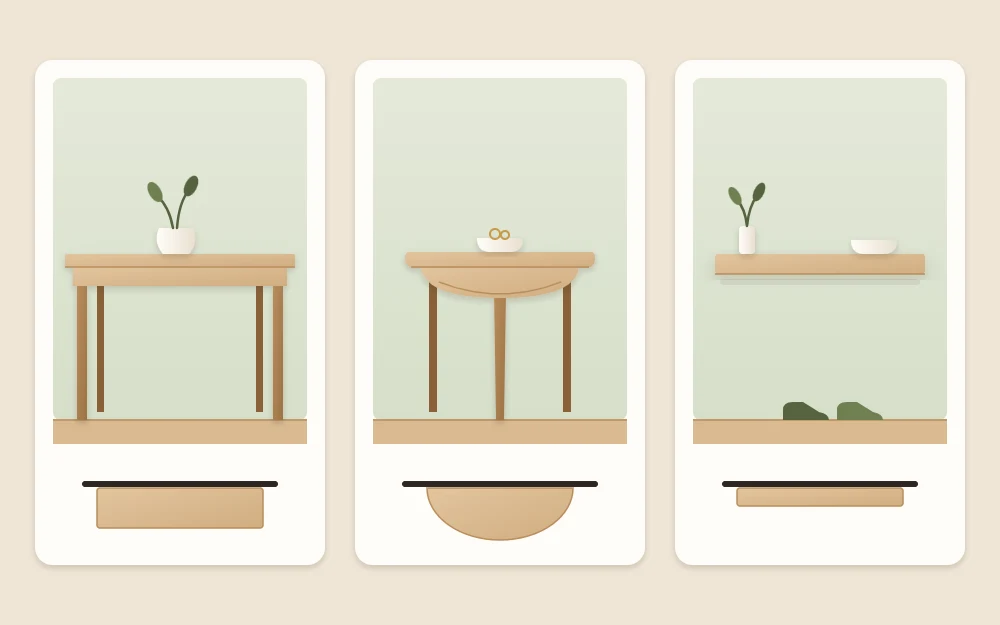
The console table comes in more shapes than the standard rectangle, and the shape changes how the same dimensions behave in a tight space.
| Shape | How it behaves | Suits | Watch for |
|---|---|---|---|
| Rectangular | Most surface for its length; strong, straight lines | Clear wall sections with a comfortable path in front | Square corners near the walkway |
| Demilune (half-round) | Deepest at the center, curving away at the ends | Tight spots and walls beside a door, where a corner would catch | Less usable surface at the ends |
| Wall-mounted ledge | Very shallow, with nothing on the floor | Tiny or corridor-like entries | Needs fixing to the wall; holds only light, small things |
Before you hang anything
For a wall-mounted console or ledge, choose fixings for your wall type and for the weight of the piece plus what will sit on it, and follow the manufacturer instructions. Get help if you are unsure. In a rental, check your lease or ask before making changes.
Mock it up with painter’s tape
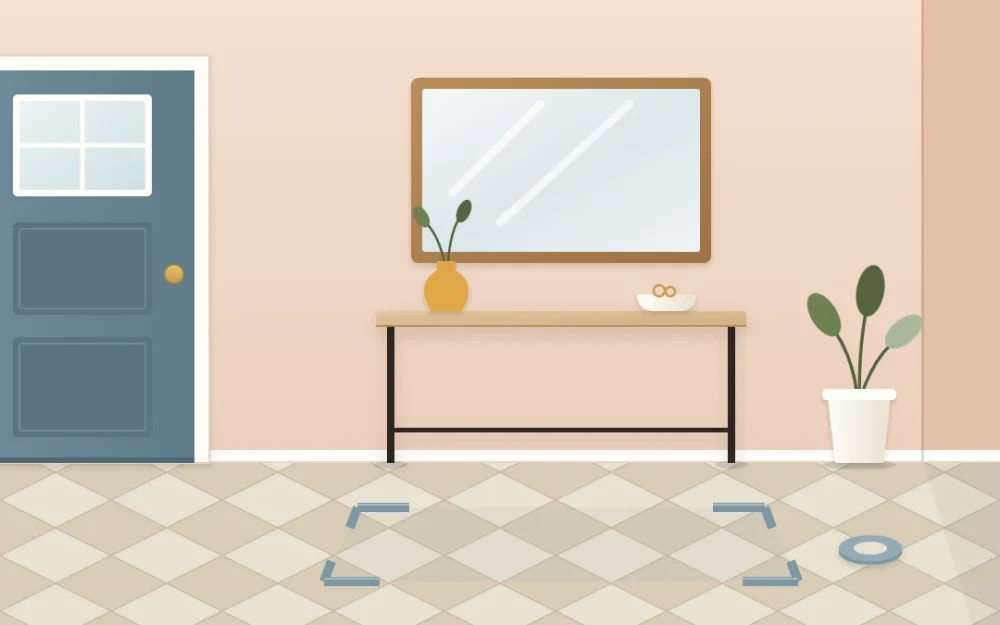
Entry table proportions are much easier to judge at full scale than on a screen. Before buying, or before moving a table you own, tape its outline in place.
- Tape the footprint on the floor. Mark a rectangle of the table’s length and depth against the wall.
- Tape the height on the wall. Run a horizontal strip at the height of the tabletop, the same length as the table.
- Tape the piece above. Outline the mirror or art you plan to use, about 6 to 8 in (15 to 20 cm) above the top strip as a common starting point.
- Open the door fully. Confirm that it clears the taped rectangle.
- Walk the route. Come in carrying a bag, pass someone if you can, and note whether you swerve around the tape.
- Look from the door. Step outside and check that the outline looks centered and in scale with the wall section.
Leave the tape up for a day or two. If you stop noticing it, the size is right. If you keep stepping over a corner, reduce the depth first, then the length. Test the tape on a hidden patch before using it on a delicate finish, since surfaces vary.
Once the size is settled
A table in the right proportions is already most of the look: it lines up with the wall, leaves the path free and gives the mirror something to sit above. What goes on top is the enjoyable part, and the step-by-step method is in the guide to styling an entryway console table.
Frequently asked questions
How long should a console table be for an entryway wall?
A useful starting point is about two-thirds to three-quarters of the wall section it sits on, measured between door casings or corners, with some bare wall left at each end. Treat that as a guide. The table also needs to stay clear of the door swing and of any switch you use.
What is the slimmest console that is still useful?
Tables around 8 to 10 inches deep are common for tight entries and still take a slim lamp, a small dish for keys and a vase. Below that, a wall ledge makes more sense than a table. Decide by measuring the walking path you want to keep in front of it.
Should the mirror be wider than the console table?
Usually not. A mirror or artwork that is somewhat narrower than the table, roughly two-thirds to three-quarters of its width as a loose guide, looks supported by the furniture beneath it. A piece wider than the table tends to look top-heavy unless the table is flanked by other substantial items.