Entryway Mirror Ideas: Shape, Size and Placement
A seven-step way to choose an entryway mirror: check the reflection first, then pick the shape, the size against the furniture below, the height and the wall.
At a glance
- Difficulty
- Easy
- Time
- About 30 to 60 minutes, plus hanging
- Best for
- Entries with a console or bench against a blank wall
- Renter note
- Needs wall fixings unless you lean a floor mirror: choose them for your wall type and ask before drilling
What you need
- Tape measure
- Painter's tape
- Pencil
- Level
- Small hand mirror
- A helper for a heavy mirror
An entryway mirror earns its place three ways: it gives you a last look before you leave, it bounces whatever light the entrance has, and it adds a sense of depth to a wall that would otherwise stop the eye. Few other pieces do that much from a single spot on the wall.
Choosing one is easier if you take the decisions in order. Work out what the mirror will reflect, then pick a shape, then a size, then a height. The steps below follow that sequence, so you can stop at whichever one you are stuck on.
Step 1: Check the reflection before the frame
What a mirror shows matters more than what surrounds it. Stand where the mirror might go, turn around, and look at what faces that wall. That view is what you will be doubling.
A window, a lamp, a doorway into a bright room or a piece of art are all worth repeating. A coat pile, a blank closet door or the side of a cabinet is not. If the view is poor, move the mirror along the wall or to the adjoining wall before you spend any time on frames.
In an entrance with little daylight, angle matters even more, because the mirror has less to work with. The guide to brightening a dark entryway covers how to place a mirror so it catches light from the next room.
Step 2: Choose a shape for the effect you want
Each shape changes the mood of the wall a little. Pick by effect, not by trend.
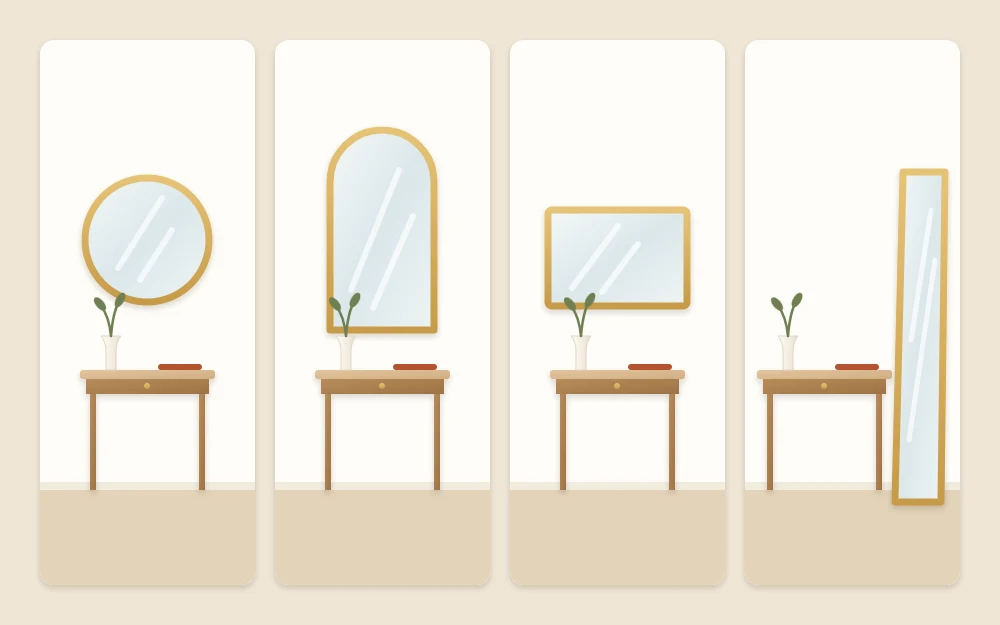
- Round. A round mirror entryway softens a space full of straight lines: door frame, console edge, baseboard. It suits a small wall because it has no corners to line up with anything.
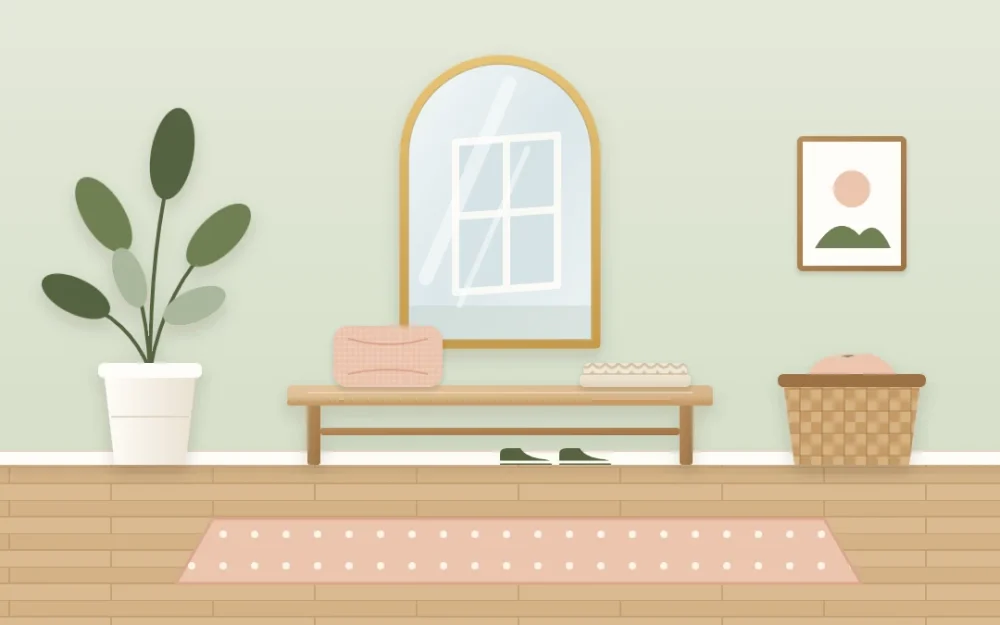
- Arched. An arch echoes the shape of a doorway and draws the eye upward, which helps a low or narrow entrance feel taller.
- Rectangular. Hung wide, it reads tailored and calm above a long console. Hung tall, it gives more of a head-to-toe view.
- Full-length leaner. A tall mirror resting on the floor against the wall looks relaxed and shows a whole outfit. Follow the maker’s guidance on securing it so it cannot slide or tip.
If the mirror is meant to be the first thing people notice, let it lead and keep the pieces around it quiet. The guide to building one clear focal point explains how to support a lead piece without crowding it.
Step 3: Size it against the furniture below
Entryway mirror size is a question of proportion, not a fixed figure. A mirror above console table or bench usually looks settled when it is narrower than the furniture, at roughly two-thirds to three-quarters of its width. Treat that as a loose guide. A mirror as wide as the table can look top-heavy, and a very small one tends to look lost.
Round mirrors follow the same idea: compare the diameter to the width of the piece below. With no furniture underneath, size the mirror to the wall section instead, leaving clear wall on each side so it does not look squeezed between a door frame and a corner.
When you are torn between two sizes, the larger one is usually the better choice for a mirror that hangs alone. A small mirror suits a wall where it shares space with art or hooks.
Step 4: Set the height
If you are wondering where to hang an entryway mirror, start with the center. A common starting point is to place the center of the mirror near eye level, about 57 to 60 in (145 to 152 cm) from the floor, then adjust for the people who use it most.
Above furniture, the gap matters as much as the center. Roughly 6 to 8 in (15 to 20 cm) between the tabletop and the bottom of the frame keeps the two pieces reading as one group. A much bigger gap makes the mirror float; a smaller one leaves no room for a lamp or a vase in front.
Check the result from two places: standing at the mirror, where you should see your face without stooping, and from the open door, where the mirror and the furniture should look like a pair.
Step 5: Decide between facing the door and beside it
A mirror directly opposite the front door reflects the door itself and, when it opens, the street or the corridor outside. Sometimes that is a fine view. Often a side wall is better, because the mirror then reflects the room you are walking into and carries its light back toward the entrance.
Beside the door also gives you a more useful last look: you can check your reflection without standing in the path of anyone coming in behind you.
Step 6: Mock it up with tape
- Measure the mirror, or the size you are considering, and note the width and height.
- Mark that outline on the wall with painter’s tape, using a level so the top edge is straight.
- Step back to the open door and look. Then walk in as you normally would.
- Move the tape up, down or sideways until the outline sits well with the furniture and the reflection.
- Lightly pencil the final top corners before you remove the tape.
Tip
Hold a small hand mirror flat against the taped outline. It gives a quick preview of what a larger mirror in that spot will reflect.
Step 7: Hang it securely
Mirrors are heavier than most framed art, so the fixing deserves care. Choose hardware to suit your wall type and the weight of the mirror, and follow the manufacturer instructions for both the mirror and the hardware. If the frame comes with its own hanging system, use it as directed.
Before you hang anything
A large or heavy mirror is a two-person job at least. If you are unsure about the wall or the fixing, get help from someone qualified. In a rental, check your lease or ask before making changes.
Once it is up, style lightly. A mirror already adds a lot of visual activity, so one lamp and one small object in front are usually enough. If the wall still feels unfinished, the roundup of wall decor to pair with or use instead of a mirror has options that sit comfortably beside it.
Frequently asked questions
Should an entryway mirror be wider than the console table?
Usually not. A mirror that is somewhat narrower than the table, at roughly two-thirds to three-quarters of its width, tends to look balanced. It is a loose guide, so tape the outline on the wall and judge it from the open door before deciding.
Is it a problem to put a mirror facing the front door?
It is a decorating choice, and it depends on the view. A mirror opposite the door reflects the door and whatever is outside when it opens. If a side wall would reflect a window, a lamp or the next room instead, that position usually gives a nicer result.
Can a full-length mirror work in a small entry?
Yes. A tall, slim mirror uses height instead of floor area and gives a whole-outfit view. It can be fixed to the wall or leaned against it. For a leaning mirror, follow the maker's guidance on securing it, especially where people brush past.