How to Create an Entryway Focal Point
Find the first wall you see from the open door, give it one lead piece, then fix the four usual problems: wrong scale, weak contrast, competing objects and an awkward first view.
Some entries have plenty on the walls and still feel as if nothing is there. A small mirror, a few frames, a hook, a little shelf: the eye hops from one to the next and never settles. What is missing is not another object but a hierarchy, one thing that leads while the rest follow.
That lead is the entryway focal point. A small space needs exactly one, and it does not have to be grand. It has to be in the right place, big enough for its wall, and free of rivals. Work through the checks below in order; most entries fail at only one or two of them.
First, find where the eye lands
Open the front door, stand on the threshold and notice what to see first at the front door as things are today. Do not look around. The wall or spot your eyes reach in the first second is where the focal point must go, because you cannot train visitors to look elsewhere.
Usually this is the wall facing the door, or the wall beside it on the side the door opens toward. Mark it mentally as the lead wall. Every other surface in the entry now has a supporting role.
Then choose one lead
Pick a single entryway statement piece for that wall. Any of these can do the job:
- A large mirror. Strong where there is light to reflect. Shapes and placement are covered in the entryway mirror ideas.
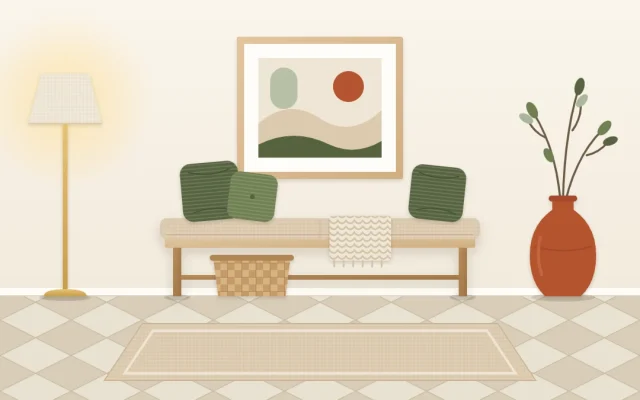
- One big artwork. A single generous piece carries color and mood better than several small ones.
- A painted or wallpapered panel. A block of color or pattern behind a console or bench turns a plain surface into an entryway feature wall without adding an object.
- A striking light. A sculptural table lamp, or a ceiling pendant where one already exists.
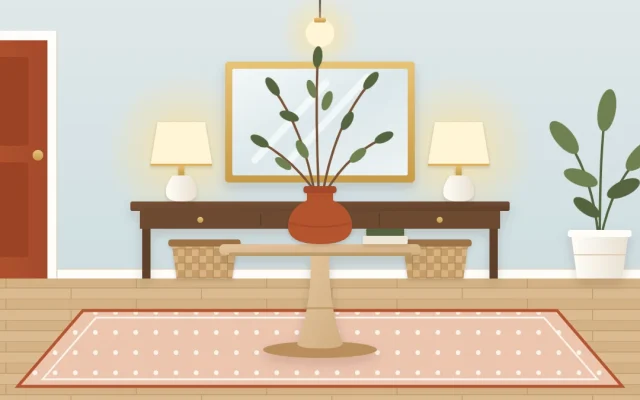
- A styled console. The table, the lamp and the piece above it, read together as one composition.
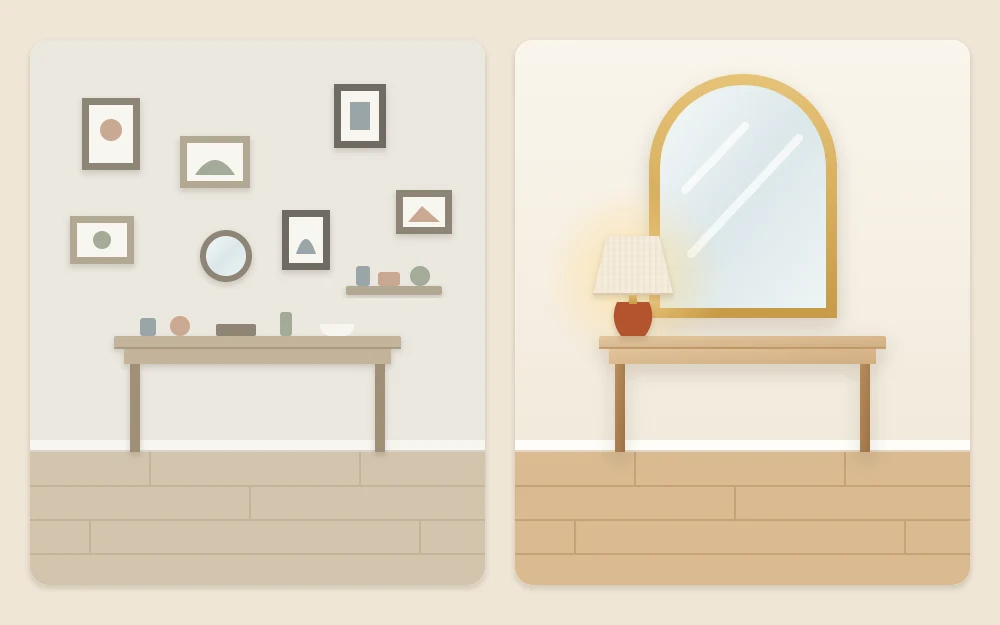
Problem: the lead is too small for the wall
How it looks: a mirror or frame that seems to float in a sea of wall, or that is visibly dwarfed by the furniture under it.
The fix: scale it to two things at once.
- The furniture below. As a loose guide, the lead should be about two-thirds to three-quarters as wide as the console or bench beneath it.
- The wall section. Leave a visible margin of bare wall on each side, but not so much that the piece looks like a stamp on an envelope.
If your piece is too small and you do not want to replace it, enlarge its presence instead: a wider mat and frame around a print, or a painted panel behind it that is larger than the piece itself. Hang it low enough to connect with the furniture, about 6 to 8 in (15 to 20 cm) above the surface as a common starting point.
Problem: it is the right size but still does not stand out
How it looks: everything is in place, yet the wall feels flat.
The fix: strengthen the lead with one or more of three tools.
Contrast
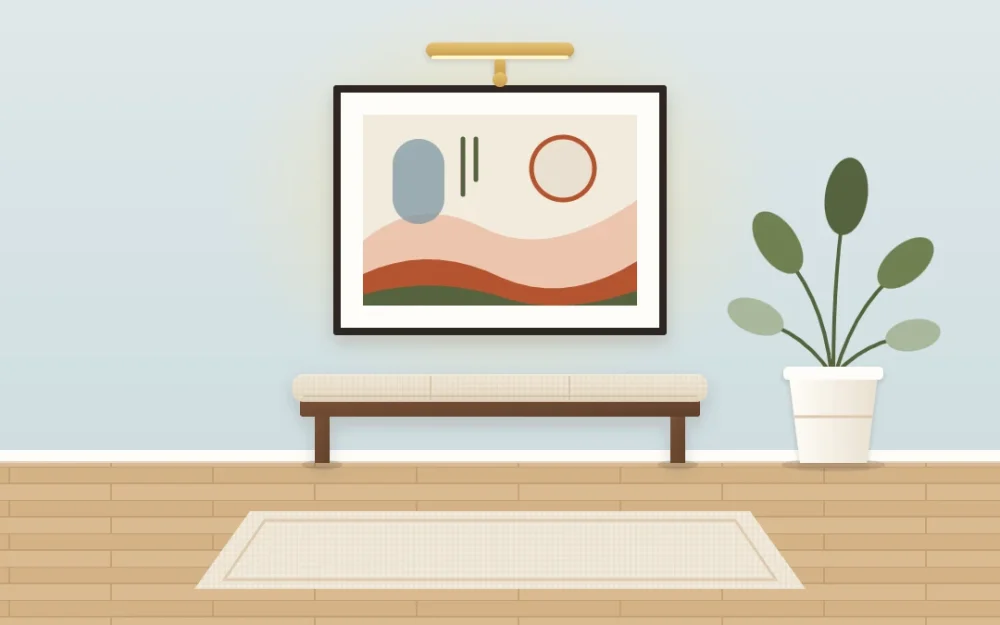
A pale frame on a pale wall disappears. Give the lead an edge the eye can catch: a dark or metallic frame on a light wall, a light mirror on a deep color, or a bold artwork against a quiet background.
Light
Whatever is brightest gets looked at first. A lamp placed beside the lead, or a battery or rechargeable picture light above it, pulls attention to the right spot after dark. For more on layering light, see the entryway lighting ideas.
Symmetry, or clear asymmetry
Centering the lead over the furniture with matching items on each side gives a calm, formal emphasis. Deliberate asymmetry also works: the lead set off-center, balanced by a tall lamp or plant on the other side. What weakens a focal wall in an entryway is the in-between, where things are almost centered and look like a mistake.
Good to know
Choosing the location for a pendant or any other wired light, and installing or replacing it, is a job for a licensed electrician, and in a rental it needs the landlord’s permission. Lamps you plug in and rechargeable lights are the simple way to add emphasis.
Problem: too many things compete
How it looks: several small items on different walls, each asking for a glance.
The fix: remove before you add. Take down everything except the lead and live with it for a day. Then return only what supports it:
- Keep items that sit below or directly beside the lead and are clearly smaller than it.
- Move good pieces that do not fit to another room.
- If you love a set of small frames, gather them into one tight group so they act as a single large piece. The method is in the guide to planning an entryway gallery wall.
Tip
Squint from the doorway. Details blur and only the strongest shapes remain. If you see one clear shape, the focal point works. If you see three or four of similar strength, keep editing.
Problem: the first view is a closet side or a hallway
Sometimes the lead wall is not a wall you would choose.
- The blank side of a closet. Treat it as a wall. It is often a neat, narrow rectangle, ideal for one tall mirror, a vertical artwork or a painted panel in a deeper color. A slim ledge or a single hook rail below completes it.
- A view straight down a hallway. Put the focal point at the far end, where the eye already goes: one artwork, a plant on a stand, or a small table with a lamp. Keep the hallway walls quieter so they lead to it.
- A view directly into the living room. Let that room hold the long view, and create a smaller lead on the wall beside the door for the moment you turn to put your keys down.
Fixing the lead in place
When you hang the piece, choose hardware for your wall type and the weight of the object, and follow the manufacturer instructions for both the hardware and the piece. Large mirrors and big framed works are heavy and awkward, so get help if you are unsure. In a rental, check your lease or ask before making changes. A large piece leaned on a console or bench is a flexible alternative; follow the maker’s guidance on securing it.
Frequently asked questions
What makes a good focal point in an entryway?
Anything large enough to hold the wall and clearly stronger than what surrounds it: a big mirror, a single artwork, a painted panel or a styled console. The object matters less than its position and scale. It should sit on the wall you see first from the door and be noticeably bigger than everything near it.
Can a small entryway have a focal point?
Yes, and it benefits even more from one, because small spaces look cluttered quickly. In a tight entry the lead might be a tall mirror on a narrow strip of wall or one framed print above a shallow shelf. Keep the other walls nearly plain so that single piece does all the work.
Should the focal point be centered on the wall?
Center it on the furniture below it first, since the two are read together. If the furniture is centered on the wall, the lead will be too. An off-center arrangement can look just as good when it is clearly intentional and balanced by a tall lamp or plant on the opposite side.