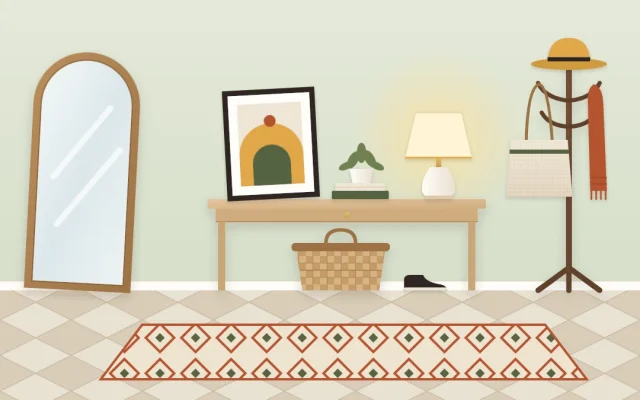
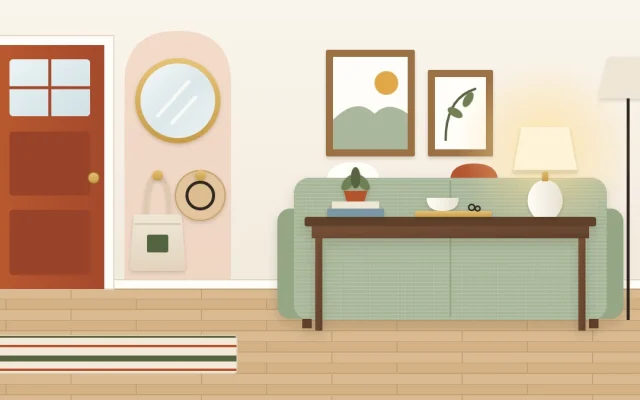
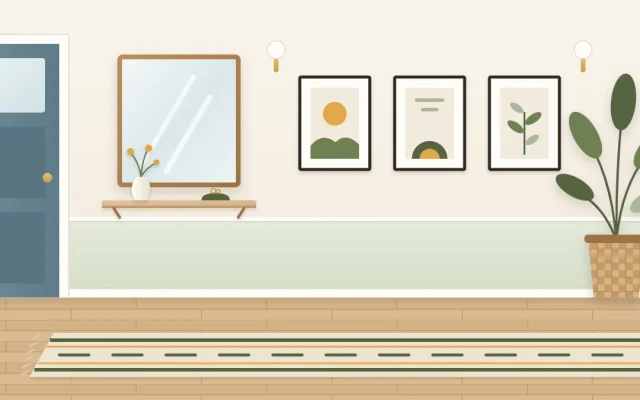
Small Entryway Ideas That Make a Tiny Entrance Feel Welcoming
Twelve ideas for a tiny entrance, grouped by effect: slim pieces that free the floor, tall shapes that use the wall, pale surfaces, one rug and accent, and a warm light.
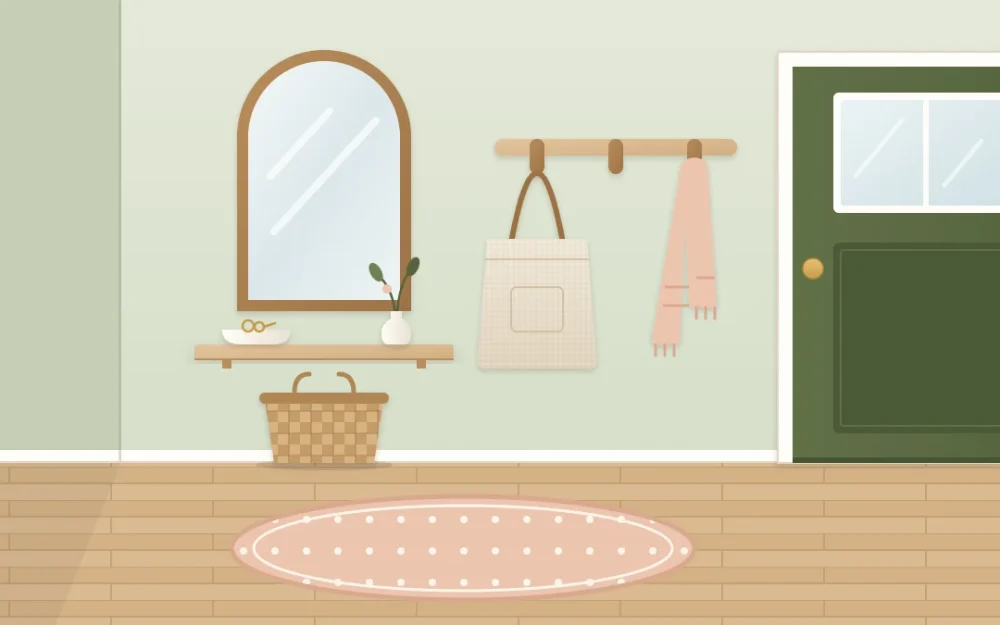
When the space inside your front door is about the size of the doormat, there is no room for a “proper” entry with a table, a bench and a coat stand. There is room for a look, though. A tiny entryway feels welcoming when a handful of well-chosen things sit in the right places and the floor stays mostly clear.
The twelve small entryway ideas below are grouped by what they do for the space: slim it down, draw the eye up, lighten it, define it and warm it. You do not need all twelve. Pick one or two from each group and stop while the entry still has air in it.
Go slim: keep the floor free
1. Swap the table for a shallow shelf
A floating shelf about 6 to 8 in (15 to 20 cm) deep gives you a surface for a dish and a bud vase without taking any floor. The open space beneath it lets the eye travel to the baseboard, which helps a tight corner read as more open.
2. Choose a narrow console on thin legs
If you want furniture, look for a console roughly 10 in (25 cm) deep with slender legs and no lower shelf. You see the wall and floor through it, so it takes up less visual room than a solid cabinet of the same size. Long, corridor-like entries need a slightly different approach, covered in these narrow entryway ideas.
3. Line up hooks in one tidy row
Three or four matching hooks in a straight line read as a single design element, where hooks dotted around the wall read as clutter. Keep to one coat and one bag per hook. The styles and spacing are explained in the guide to decorative entryway hooks.
Go up: use the height you have
4. Hang one tall mirror
A tall, slim mirror, arched or rectangular, pulls the eye upward and makes use of wall that would otherwise sit empty. It also gives you a full last look before leaving. One generous mirror suits a small wall better than several little ones. See the entryway mirror ideas for shape and height.
5. Stack art vertically
Two or three frames placed one above the other fit on a wall sliver beside the door where a wide picture never could. Keep the frames identical and the gaps even, about 2 to 3 in (5 to 8 cm) as a rule of thumb, so the stack reads as one tall piece.
6. Raise the hooks or shelf a little
Placing the shelf or hook row slightly above shoulder height leaves a clean band of wall below it. In small foyer ideas of this kind, the clear band matters as much as the objects, because it is what keeps the wall from feeling crowded at elbow level.
Lighten: let surfaces bounce what light there is
7. Keep walls and large pieces pale
Cream, soft white or a pale tint on the walls, with furniture in light wood or the wall color itself, lets the edges of a tiny space blur a little. Save darker tones for small things such as a frame, a hook or a vase, where they add definition without weight.
8. Put the mirror beside or opposite the light
A mirror placed next to a glazed door panel, or across from the opening to a brighter room, picks up that light and spreads it around the entry. Check the reflection before you commit: a view of a window or a plant is worth having, while a view of the coat pile is not.
Define: mark the entry as a place
9. Lay one small rug
A rug tells the eye where the entry begins and ends, which is especially useful in apartment entryway decor where the door opens onto a hallway or straight into a room. Choose a flat-woven one that the door clears, put a rug pad suited to your floor type underneath, and keep it outside the door swing if the gap under the door is tight. If you have no separate entry at all, see how to create an entryway in an open room.
10. Use a single accent color
Pick one color and repeat it two or three times: in the rug, on a vase, in a print. A tiny space cannot absorb several competing colors, but one repeated accent makes a few scattered items look like a set.
Warm up: add glow and something living
11. Add a small lamp
A compact lamp on the shelf or console gives the entry a soft pool of light at dusk, which feels far more inviting than overhead light alone. Where there is no socket nearby, a rechargeable table lamp or a battery light does the same job with no cord to hide.
12. Bring in one small plant
A single trailing plant on the shelf, or one stem in a bud vase, adds life without using floor space. In an entry with little daylight, dried stems or a good faux plant keep the same shape and color with none of the struggle.
Combining the ideas without crowding
Small entryway decor works by restraint, so build in layers and stop early. A reliable combination for a very tight corner is:
- one slim surface (idea 1 or 2),
- one tall element above or beside it (idea 4 or 5),
- one row of hooks,
- one small rug,
- one source of glow or one plant.
Tip
Count the items you can see from the door. In a tiny entry, around seven visible things, furniture included, is a comfortable upper limit as a rule of thumb. Past that, remove one for each one you add.
Fixing shelves, hooks and mirrors to the wall
Most of these ideas rely on the wall, so take the mounting seriously.
Before you hang anything
Choose fixings for your wall type and for the weight of the shelf, hook rail or mirror, including whatever will sit or hang on it, and follow the manufacturer instructions. Ask someone to help with a tall mirror if you are unsure. In a rental, check your lease or ask before making changes.
If fixing to the wall is not an option, a slim freestanding console with a mirror leaned on top gives a similar effect and moves with you. Follow the maker’s guidance on securing any leaning piece.
Frequently asked questions
What furniture fits in a very small entryway?
Often none on the floor, and that is fine. A shallow floating shelf or picture ledge gives you a surface for keys and a vase. If there is a little more room, a narrow console on thin legs works well because you can see the wall and floor through it, so it looks lighter than a cabinet.
Where should a mirror go in a tiny entry?
Place it where it reflects something worth seeing, ideally beside or across from a source of light such as a glazed door panel or the opening to a brighter room. A tall, slim mirror uses wall height and suits a narrow strip of wall. Check the reflection from the door before you fix it in place.
How do I stop a small entryway from looking cluttered?
Limit what is visible. Keep hooks in one straight row with one item each, use a single small dish for keys, and repeat one accent color instead of several. Leaving a clear band of wall and most of the floor open does more for the look than any extra decorative piece.