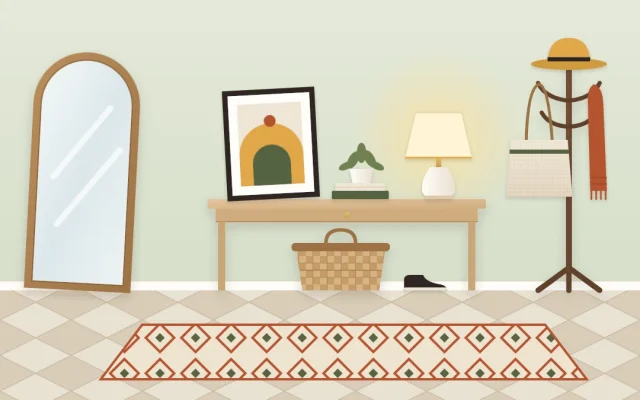
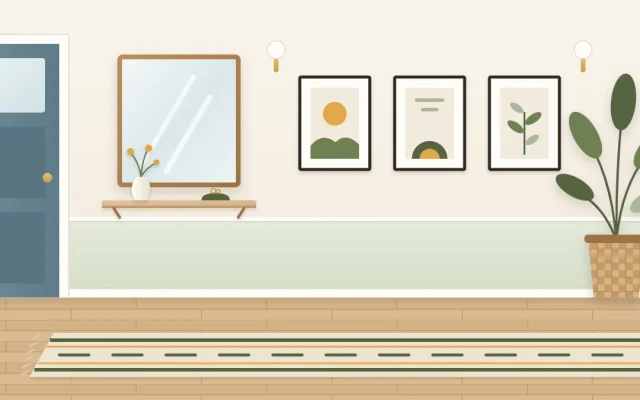
No Entryway? How to Create One When the Door Opens Into the Living Room
How to give a front door that opens into the living room a defined arrival spot using a rug, a wall moment, furniture as a boundary, a lamp and one color accent.
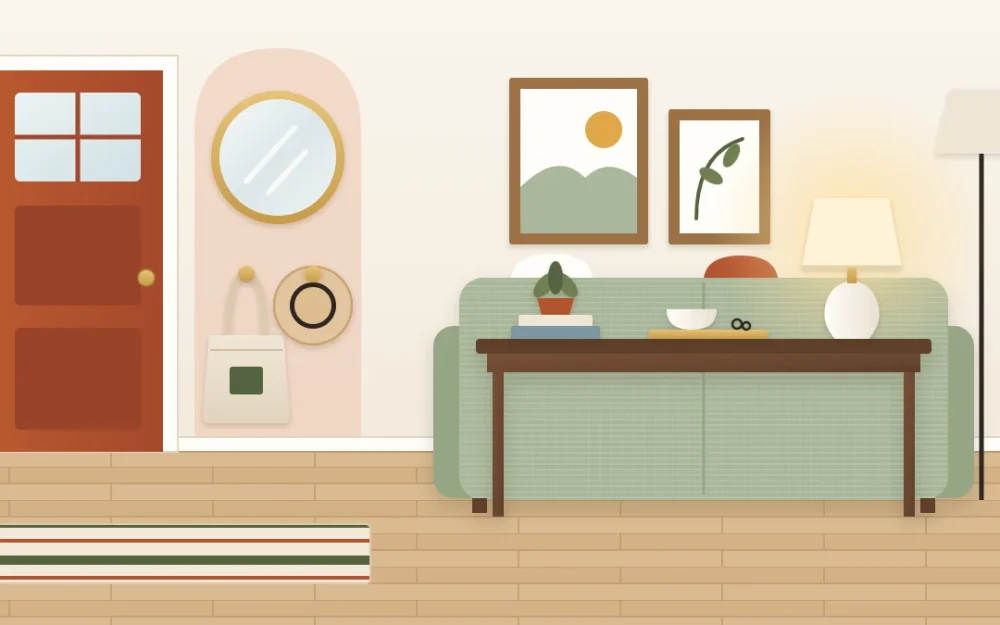
When the front door opens straight onto the sofa, there is no pause between outside and home. Coats land on the armchair, shoes drift across the living room rug, and guests step in without knowing where to stand.
Having no entryway does not mean you need a wall or a partition. An entry is really just a few signals that say “arrive here”: a patch of floor, a spot on the wall, a surface and a light. Put those four together within a step or two of the door and the room gains a defined arrival point while staying open.
Define the floor first
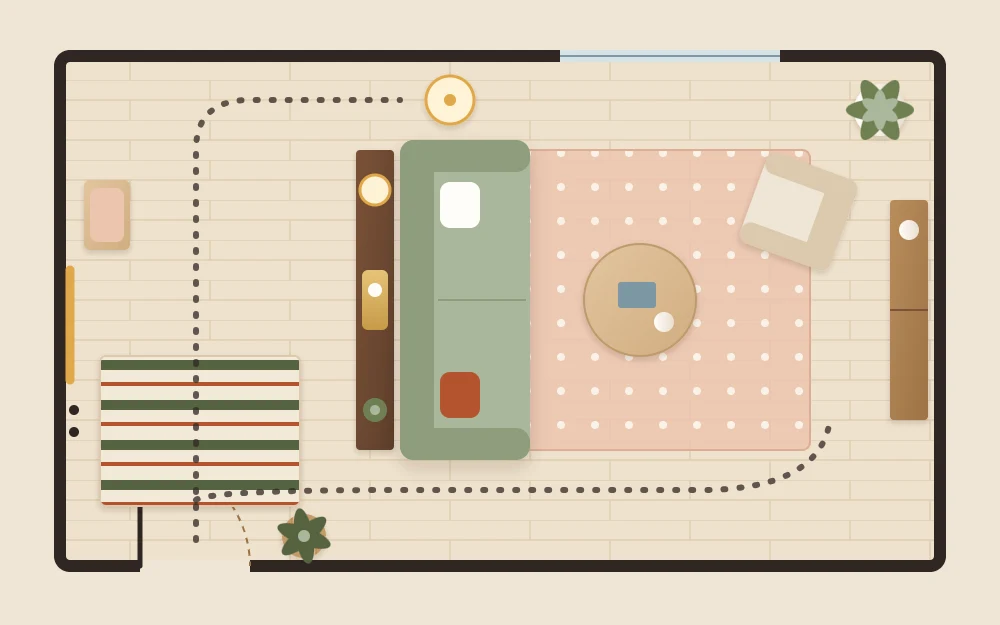
A rug is the quickest way to define an entry in an open room, because it draws the outline that walls would normally draw. Choose a rug or short runner that is clearly separate from the living room rug, with a strip of bare floor between the two, so the eye reads two zones.
Keep it flat enough for the door to pass over, and place it so the door swing stays clear. A rug pad suited to your floor type helps it stay in place. Sizes, shapes and door clearance are covered in the entryway rug and runner guide.
Give the zone a wall moment
Next, claim a piece of wall beside or near the door. It only needs to be about as wide as the rug. Two combinations work in almost any room:
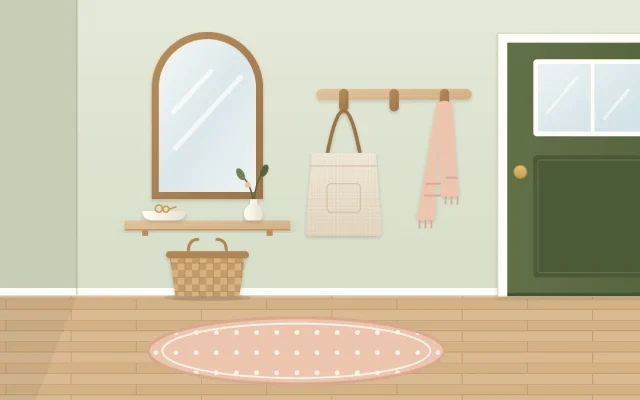
- A mirror plus two or three hooks. The mirror gives the zone a face and bounces light; the hooks give coats and bags a place that is not the sofa.
- A shallow ledge with art above. A narrow shelf for keys and a small vase, with one print over it, reads as a tiny console without taking any floor.
Before you hang anything
Choose hardware to suit your wall type and the weight of the mirror, ledge or hooks, and follow the manufacturer instructions. Get help with a heavy mirror if you are unsure. In a rental, check your lease or ask before making changes.
Use furniture as the boundary
Furniture can do the work of a wall while letting light and conversation pass. Three pieces are especially useful when the door opens into the living room.
- The back of the sofa with a console behind it. Turn the sofa so its back faces the door, then place a slim table along it. The table becomes the entry surface and the sofa becomes a low divider. Check the proportions against the guide to console table size so the table does not stand taller than the sofa back or pinch the path.
- An open shelving unit. Set at a right angle to the wall beside the door, a unit with open shelves screens the seating area and still lets daylight through. Style the shelves facing the door with a basket, a plant and a bowl. Follow the maker’s guidance on securing any tall piece.
- A bench. A bench placed side-on to the door marks a soft edge at knee height and gives you somewhere to sit for shoes.
Mark the zone with light and color
A separate pool of light is one of the strongest faux entryway ideas, because rooms are read by their lighting after dark. Give the zone its own lamp: a small table lamp on the console or ledge, plugged in or rechargeable, switched on at dusk. The glow says “entry” even when the rest of the living room is lit differently.
Then add one color signal that belongs only to this spot. It could be a rug in your accent color, a painted panel behind the mirror, a colored door interior or a bold vase. If you rent, check your lease or ask before making changes such as painting.
Keep the living room palette
The entry zone should look like the opening line of the living room, not a different room that wandered in. Use the same base colors and the same wood tone, and repeat one material from the seating area, such as the linen of the cushions or the black metal of a floor lamp.
The entry’s accent can be a stronger version of a color the living room already has. If the sofa cushions are soft olive, the entry rug can be a deeper olive. That keeps the two zones distinct and related at the same time.
Three layouts to copy
Door on the long wall
When the door sits in the middle of a long wall, you walk into the side of the room. Place a runner parallel to the wall, leading away from the door toward the natural walking route. Put the mirror and hooks on the wall directly beside the door on the latch side, and a bench or a slim console under them. Keep the nearest armchair turned slightly away from the door so the seating group closes itself off.
Door in a corner
A corner door gives you two walls to work with and a ready-made nook. Use the short return wall beside the door for hooks and a mirror, and place a small rug square in the corner. A tall plant or a floor lamp at the outer edge of the rug acts as a soft post marking where the entry ends and the living room begins.
Door behind the sofa
If the door opens toward the back of the seating, let the sofa be the divider. Leave a clear walkway between the door and the sofa back, lay the rug in that strip, and set the console against the sofa with a lamp at one end and a tray for keys. A mirror goes on the side wall so you pass it on the way in.
What to keep out of the zone
To create an entryway inside a living room, you have to be stricter than you would be in a real hall, because everything stays in view from the sofa.
- Keep the number of pieces low: one surface, one wall moment, one rug, one lamp.
- Choose closed baskets or a lidded box for small things so the living room does not look at clutter.
- Limit what hangs on the hooks to the items in daily use.
- Leave the walking path from the door into the room clear.
Many of the tricks for tight spaces apply here too. The small entryway ideas list slim pieces and vertical moves that suit a corner of a living room just as well.
Frequently asked questions
How do you separate the front door from the living room without a wall?
Use decor to mark the boundary. A rug sets the floor area, a mirror with hooks or a ledge claims a piece of wall, and a piece of furniture such as a sofa back with a console, an open shelving unit or a bench forms a low divider that still lets light through.
What size rug works when the door opens into the living room?
Choose one that is clearly smaller than, and separate from, the living room rug, with bare floor between them. It should sit clear of the door swing and be flat enough for the door to pass over. A short runner suits a door on a long wall; a small rectangle suits a corner.
Where do coats and shoes go with no entry hall?
Give them a small, limited home within a step or two of the door: two or three hooks for the coats in daily use, and a closed basket or a bench for the day's shoes. Keep everything else in a closet so the living room does not look out on clutter.