Entryway Shoe Storage Ideas That Still Look Styled
Shoes by the door can still look styled. Choose between hiding and showing, dress a shoe cabinet like a console, frame the day's pair and fix the usual messy spots.
Shoes are the hardest thing to make look good by the door. They are dark, mismatched, different heights, and there are always more of them than the space was planned for. A beautiful mirror cannot compete with nine pairs in a heap beneath it.
Good entryway shoe storage is therefore a styling decision before it is a furniture decision. The aim is not to build a system for every pair you own. It is to control what the eye meets at the door: either no shoes at all, or a small, neat group that looks placed.
Decide first: hide or show
Every approach falls into one of two camps, and mixing them without a plan is what creates the mess. Pick one as your main approach, then allow a small exception from the other.
Hiding
- A slim closed cabinet. Shallow cabinets with tilting fronts or plain doors present a flat, calm face to the room. They are the surest way to hide shoes in entryway spaces where everything is on view. Because they are tall for their depth, follow the maker’s guidance on securing the cabinet.
- Lidded baskets. One large basket with a lid takes soft shoes, slippers and sandals. The weave adds warmth, and the lid keeps the outline tidy. The entryway basket ideas cover materials and sizes.
- A bench with doors or a closed base. Seat on top, shoes out of sight below. It reads as furniture, not storage.
Showing
- A low open rack with a strict limit. One or two shelves and a fixed number of pairs, set by the width of the rack. When it is full, something leaves.
- A tray for the day’s pair. A single tray on the floor for the shoes you wore today. Everything else goes back to the closet.
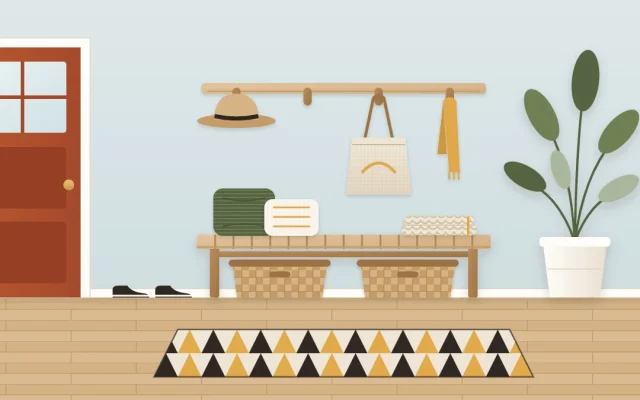
- A neat row under an open bench. Three or four pairs, toes out, lined up to the front edge. For shoe bench styling to work, the row has to stay shorter than the bench; the entryway bench ideas show how the seat, cushions and the space below fit together.
Style the top of a shoe cabinet like a console
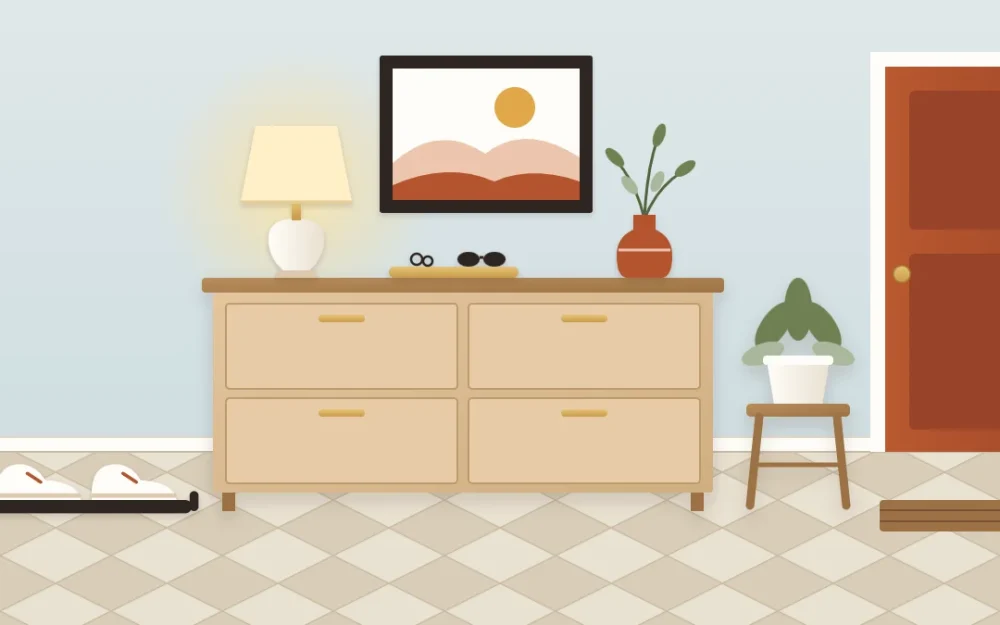
A closed cabinet gives you a bonus: a surface at about console height. Use it, because shoe cabinet decor is what stops the piece from looking like a locker.
- Put something tall at one end: a table lamp or a vase of branches.
- Add a small tray or bowl for keys near the side closest to the door.
- Balance the other end with one low object, such as a stack of two books or a small plant.
- Place a mirror or a framed print on the wall above, centered on the cabinet, or lean a frame against the wall.
- Leave about a third of the top empty, as a loose guide, so it does not become a dumping spot.
Styled this way, visitors see a console with a lamp and art. The shoes behind the doors are no longer part of the picture.
Match the finish to the palette
Storage furniture is often the largest block of color in an entry, so its finish matters more than its fittings.
- For a piece that recedes, choose a finish close to the wall color. A white cabinet on a white wall almost vanishes.
- For a piece that acts as furniture, choose wood in the same tone as the floor, the bench or the mirror frame.
- Repeat the handle finish once elsewhere, in a lamp base or the hooks, so the cabinet belongs to the room.
- Avoid a third wood tone. Two is usually the limit before an entry starts to look pieced together.
Frame the pairs that stay out
Shoes standing directly on the floor look dropped. The same shoes on a defined base look parked. A frame is the difference.
A boot tray is the classic answer. Choose one in metal, rubber or a dark matte finish with a clear raised edge, and size it for two or three pairs, not six. Filling the tray with a layer of smooth pebbles turns it into a small feature: wet soles drain between the stones, and the texture looks deliberate even when the tray is empty.
A small flat mat in a solid color does a similar job in dry weather. Line it up with a wall, the edge of the cabinet or a floorboard so it sits square.
Tip
Set pairs with heels to the wall and toes pointing into the room. Toes are the tidier end of a shoe, and a row of them reads as a single line.
Keep only this season in view
Whatever you show should match the weather outside. Sandals beside snow boots look like clutter even when they are lined up, because the eye registers them as leftovers. Move off-season pairs to a bedroom closet and let the entry hold only what is in rotation now.
The same goes for numbers. A helpful limit is one pair per person on show, with a second allowed behind closed doors. Guests’ shoes can share the tray or the rack for the evening.
Why shoe storage looks messy, and the small fix for each
If the entry still looks untidy, run through this list. Shoe storage styling usually fails for one of six reasons, and each has a modest fix.
- Problem: an open rack that is taller than it is wide. A tower of shoes dominates the wall. Fix: go low and long, or switch to a closed cabinet.
- Problem: shoes spill past the storage. The overflow is what people see. Fix: set a number that fits and move the rest elsewhere.
- Problem: a wire rack in a soft, warm entry. The material fights the rest of the decor. Fix: choose wood or a painted finish from your palette.
- Problem: nothing above the storage. A bare wall makes the shoes the focal point. Fix: add a lamp, a print or a mirror to lift the eye.
- Problem: mixed directions. Pairs pointing every way look chaotic. Fix: toes out, pairs together, in one row.
- Problem: the storage blocks the door or the path. A deep unit makes the whole entry feel crowded. Fix: choose a shallower piece; the small entryway ideas suggest slim alternatives.
Frequently asked questions
How do I hide shoes in a small entryway?
A slim closed cabinet is the calmest option because it shows a flat front and takes little depth. A lidded basket or a bench with a closed base also works. Whichever you choose, keep one tray out for the pair worn that day so shoes do not collect on the floor.
What should go on top of a shoe cabinet?
Treat it like a console table. Place a lamp or a tall vase at one end, a small tray or bowl for keys, and one low object at the other end, then add a mirror or framed print on the wall above. Leave part of the surface clear.
How many pairs of shoes should be on show by the door?
There is no rule, but a useful limit is about one pair per person, all from the current season. A small, even row or a single tray looks deliberate, while a larger collection starts to dominate the wall however neatly it is arranged.