Entryway Decorating Ideas: Where to Start With Any Entrance
A sensible order for decorating any entrance: read the space from the open door, limit the palette, place one anchor piece, then add the mirror, rug, lamp, plant and a landing spot for keys.
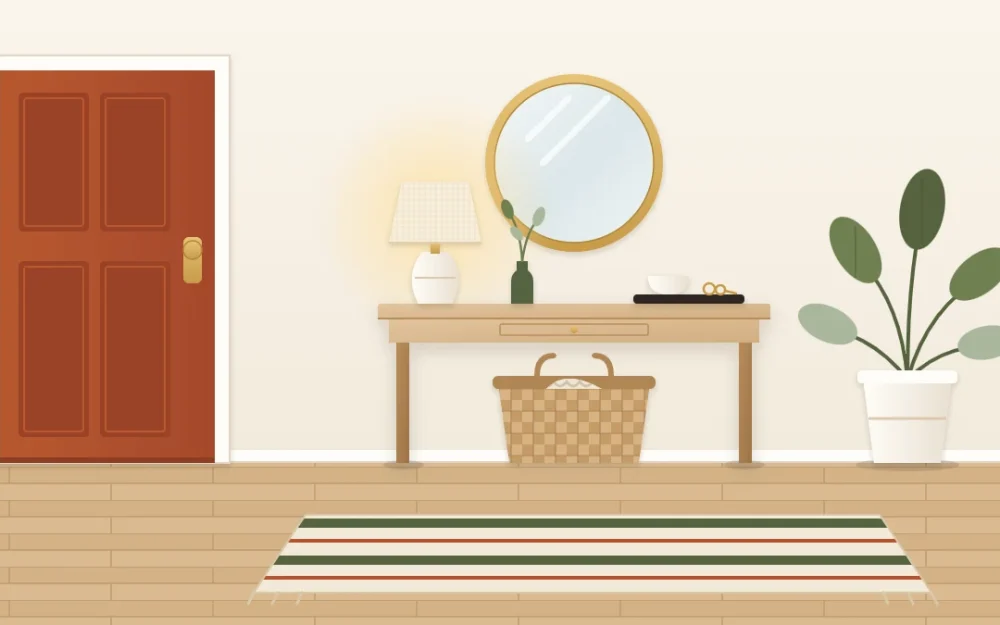
Most entryway decorating ideas begin with a shopping list: a mirror, a table, a basket. The entrance usually turns out better when you begin by looking instead. An entry is often the smallest space in a home, and everything in it is seen from one spot, in a few seconds, by someone holding a bag.
So before you buy anything, work in an order. The sequence below is how to decorate an entryway from a bare or cluttered start: read the space, pick the colors, place one main piece, then layer the smaller things on top. Each step narrows the choices for the next one, which is what makes it a useful approach to entryway decor for beginners.
Stand at the open door first
Open the front door, step outside and look in as a visitor would. Note three things before you move a single object.
- What you see first. One wall or corner usually catches the eye before anything else. Your best piece belongs there. If that spot is currently a coat pile or the blank side of a closet, the guide to creating an entryway focal point explains how to handle it.
- The walking path. Trace the line your feet take from the door into the home. Nothing you add should sit on that line or make you turn sideways to pass.
- The light. Notice where daylight comes from, if there is any, and how the entry looks at dusk. A dim entry needs paler surfaces and a lamp far more than it needs extra objects.
Then swing the door fully open and mark where its edge stops with a strip of painter’s tape on the floor. Everything you place later stays outside that arc, with a little room to spare for a hand on the handle.
Choose a restrained palette
An entry is too small to carry many colors. Three is plenty: a light base, a supporting neutral such as wood or woven fiber, and one accent you repeat two or three times. Borrow the accent from the room you can see from the door, so the entrance reads as the opening line of the home instead of a separate box.
Settle this before the furniture. Knowing that your accent is olive or rust makes every later decision quicker, from the lamp base to the rug to the plant pot. The full method for picking and limiting colors is in the entryway color palette guide.
Place one anchor piece
Every entry needs one piece of furniture that the rest gathers around. Choose one, not three:
- A console table if you have a clear stretch of wall and room to walk past it.
- A bench if a place to sit and deal with shoes matters more than a surface.
- A shelf or ledge if the floor is too tight for anything with legs.
Judge its scale against the door, because the door is the largest shape in view. A piece much narrower than about half the door’s width tends to look lost beside it, while one far wider than the door starts to take over. Depth matters more than length. A common starting point is to keep roughly 36 in (91 cm) of clear walking width in front of the piece, and more if the space allows.
Add the mirror or art above it
The wall above the anchor piece is the second half of the same composition. Choose a mirror or one piece of art, not both. As a loose guide, aim for about two-thirds of the width of the furniture below, and keep it low enough to feel connected: a gap of about 6 to 8 in (15 to 20 cm) above the surface is a common starting point.
A mirror suits an entry that has some light to bounce around, and it gives you a last look on the way out. Art is the better choice when a mirror would only reflect a closet door or a dark hallway.
Before you hang anything
Choose hanging hardware for your wall type and for the weight of the piece, and follow the manufacturer instructions that come with both. A large mirror is awkward to lift alone, so get help if you are unsure. In a rental, check your lease or ask before making changes. Leaning a framed piece on the console is a lower-commitment alternative.
Layer the floor, the light and one plant
With the main wall settled, add three supporting layers in this order.
- A rug or runner. It marks the entry as a place of its own, even when the door opens straight into a larger room. Pick a flat-woven or low-pile one that the door can pass over, and add a rug pad suited to your floor type.
- A lamp. A table lamp on the console, either one you plug in or a rechargeable one, gives low warm light at dusk. That glow at table height does more for the mood than overhead light alone.
- One plant. Choose a single plant with a clear shape, or a vase of branches or dried stems if the entry is dark. One reads as a choice; five small pots read as clutter.
Finish with a landing spot
Keys, sunglasses and mail will land somewhere, so give them a good-looking home: a small tray, a shallow bowl or a lidded box, placed where your hand naturally reaches as you come in. Keep it to one container. Everything outside it is decoration, and everything inside it is allowed to be untidy.
Arranging the rest of the surface, with height at one end and a lower group at the other, is covered step by step in the guide to styling an entryway console table. If daily life keeps swamping the look, read about balancing decor and function in an entryway next.
What to leave out
Front entrance decorating usually goes wrong by addition. Before you call the entry finished, walk back to the open door and check for the usual extras:
- A second small table or stool that narrows the path.
- Several little frames scattered around the main piece.
- A rug so small it looks like a mat that wandered indoors.
- More than one accent color.
- Anything that the door touches when it opens.
A welcoming entryway is rarely the fullest one. It has a clear path, one thing worth looking at, a warm light and a place to put your keys down. Get those four right and the remaining decisions become small ones.
Frequently asked questions
What should I decorate first in an entryway?
Start with the wall you see first from the open door. Decide on a small palette, then place one main piece of furniture on that wall, such as a console, bench or shelf. The mirror or art, rug, lamp and plant all follow from that piece, so choosing it early saves you from buying things that do not fit.
How many pieces of furniture does an entryway need?
Usually one. A single console, bench or shelf gives the entry a center and leaves the walking path open. A second piece only makes sense in a larger foyer where you can still walk past everything comfortably and the door opens fully without touching anything.
How do I decorate an entryway that has almost no space?
Use the wall instead of the floor. A shallow shelf or ledge, a mirror above it and a small rug can do the same job as a full console arrangement. Keep the swing of the door clear, limit yourself to one accent color, and add a small rechargeable lamp if the corner is dim.